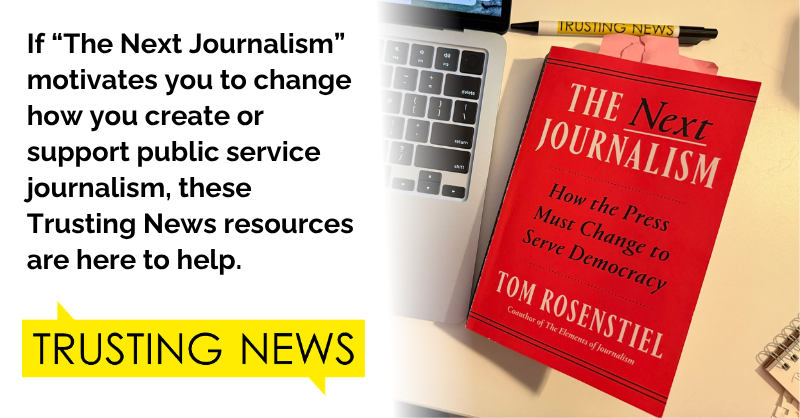
This chapter-by-chapter guide weaves our 10 years of research into the themes in Tom Rosenstiel’s new book.
Putting “The Next Journalism” into practice: a reading companion from Trusting News
In “The Next Journalism,” Tom Rosenstiel lays out a bold vision for mission-driven journalism, demonstrating how service-oriented journalists could both reimagine their role and rebuild their relationship with the people they aim to serve.
Our team worked closely with Tom at the American Press Institute, when he was API’s executive director and Trusting News was co-hosted there (along with the Reynolds Journalism Institute). So it wasn’t a surprise to find so much alignment between his vision and the work we’ve been doing to create normative change in journalism.
I made so many notes about the overlaps as I read the book that I thought I’d share some here. Our goal at Trusting News is to be relentlessly practical and actionable. My hope with this reading companion is to provide on ramps from Tom’s ideas to Trusting News resources and strategies, in case “The Next Journalism” motivates you to change how you create public service journalism.
And please join us for a live discussion and Q&A with Tom from 2–3 pm ET on Tuesday, Sept. 29: “The Next Journalism” and earning the public’s trust. Register here.
Chapter 1: The Job to Be Done
Tom’s provocative kickoff invites new ways of thinking about what journalism is here to do. And the best way to know if what we’re offering is relevant and useful is to ask the people whose verdict actually matters. For years, our cohort programs have all begun with community listening. When journalists spend time talking to the people they wish they were reaching, the experience is a positive one for journalists and for the members of the public, who actually report increased trust in and willingness to pay for news after just one conversation.
In our dream world, journalists across an ecosystem would collaborate on listening efforts and be continually building their shared understanding of who feels neglected or misrepresented by journalism and what is needed to build equitable offerings.
- Trust Kit on Listening
- Our basic community interview guide
- Step-by-step guide to collaborative listening across an ecosystem
- Use our survey to make election coverage more relevant
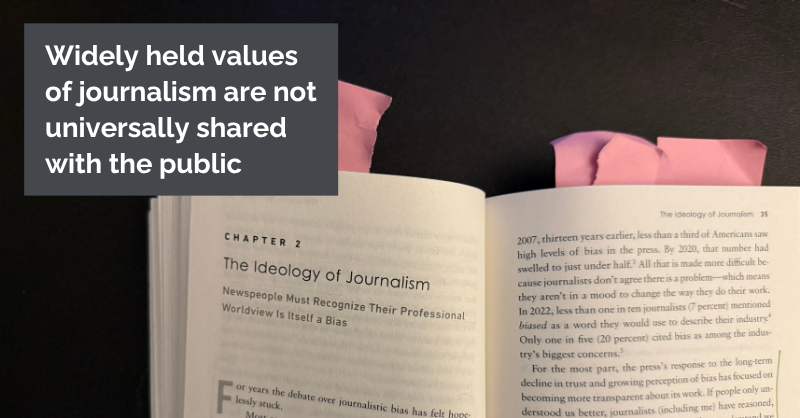
Chapter 2: The Ideology of Journalism
“… Journalism is a kind of professional ideology — a way of seeing the world — that journalists not only fail to recognize but that separates them from the public in ways journalists do not recognize or understand.” (p. 35)
We have been talking about how the ways journalists are different from the public — and how those differences show up in coverage — since 2020. My Nieman Lab prediction for journalism in 2022 was about “being honest about how journalists are different from their communities.”
- The key resource I’ll point to here is a course we created with Eve Pearlman of Spaceship Media designed to help newsroom teams assess the makeup of their staff and their personal and collective views, values and limitations. That course became our Dimensions of Difference Newsroom Guide and in-person workshop, along with remote training offerings.
Journalists talk a lot about being unbiased and fair. But as Tom says, a failure to understand their own biases “makes them more susceptible to the trap of mistaking their intention to be fair with actually being fair.” (p. 49)
Chapter 3: What Psychology Can Teach Journalism
“Journalism’s responsibility extends beyond preaching to choirs.” (p. 63)
The dozens of newsrooms that have been through the Advancing Democracy program or our Beyond the Bubble training have had this drilled into them. Our strategies cover how you introduce yourselves and your work to the community, how you interview, how you frame and craft stories and how you seek and be responsive to feedback. A few highlights:
- An overview of our work on this topic since 2020 is here: Humility, bias and pluralism: the Trusting News approach.
- Tom quotes in the book from a core offering: our Anti-Polarization Checklist.
- One topical example: Provide on ramps to terminology describing trans people
Chapter 4: The Argument over Objectivity Gets Us Nowhere
Tom’s journey through the problematic language of objectivity and toward the language of “open-minded inquiry” points to what the public most wants from journalism but often feels like they’re not getting. It speaks to the need to make the method of journalism more transparent, such as by directly addressing what you don’t know or helping people do their own research.
In our workshops, we take journalists through an exploration of what they’re striving for (Being unbiased? Neutral? Even-handed? Fair? Impartial? Independent?). Our goal is not to be prescriptive. It’s to prompt the kind of self-reflection Tom calls for and then encourage journalists to be public with and accountable for their promises.
And one more overlap with our Dimensions of Difference work comes on p. 113, when Tom writes about intellectual diversity in newsrooms: “What’s clear is that representation alone is not enough; it needs to be backed by a culture that invites a broad range of views into conversations about story choice and story framing.” We assess how well newsroom cultures invite and respect dissent, and then we suggest processes for improvement.
Chapter 5: News as Collaborative Intelligence
This chapter is a stellar exploration of how community experiences and expertise can guide journalists as they set their own agenda and gather information. It’s about the role the public can and should play, if journalists are willing to be led. Some related resources of ours:
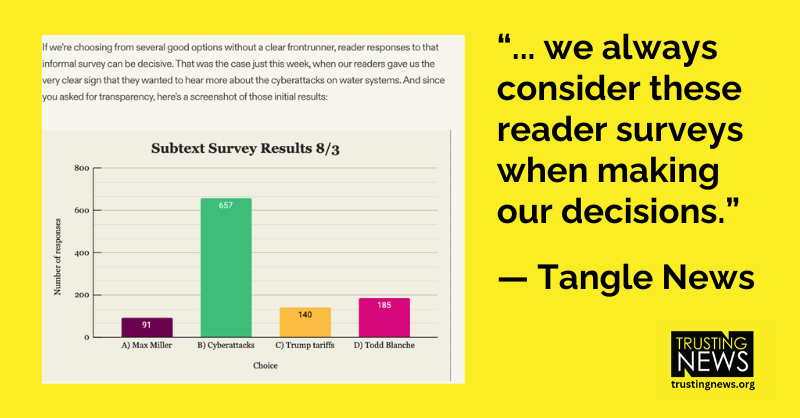
- Trust Kit: Seeking audience input (and acting on it)
- Advice from journalists: Why we’ve invested in listening to people who don’t trust us
- Trust Kit: Investing in the comments
- Hosting AI literacy events built on collaboration, not just broadcasting information
The chapter also references research about how coverage of elections and democracy changed when journalists were guided by Trusting News, Hearken and Solutions Journalism. This follow-up research paper from Dr. Sue Robinson and Dr. Josh Darr demonstrates that audiences preferred the engaged, transparent approach.
Chapter 6: The Third Leg of Journalism’s Collaborative Intelligence
This chapter is about the Civic Internet. It’s about making data legible. It’s about understanding what humans do best and deploying AI creatively and smartly. As API’s Robyn Tomlin told Tom on page 185: “We can do AI or we can have AI done to us.”
Since 2024, we’ve been helping journalists keep the public at the center of their decision-making around AI. Through our work with newsrooms and several research studies, we have these core findings and recommendations:
- Start with listening, using this survey to learn how your community feels about AI and this interview guide to dive deeper.
- Be transparent about your practices, with an AI use policy and in-story AI use disclosures.
- Help your community navigate AI using our AI Literacy Trust Kit, which includes an AI Literacy Quiz, AI Literacy social content, AI Literacy event agendas and more.
Chapter 7: Beyond Storytelling
“… for many people, the news feels intimidating and off-putting — like a party where you arrive late, barely know anyone, and quickly leave.” (p. 196)
Unless your only job to be done is serving insiders and news enthusiasts, your journalism must work harder to invite people to get to know both you and the topics you’re covering.
- Get to know you: Write a simple FAQ and some Reporter Mission Statements. But don’t just pat yourself on the back for having them; link to those elements routinely from daily coverage.
- Get to know your coverage: How do you know something is true? What is your approach to breaking news? Learn to anticipate questions, then proactively answer them.
Chapter 8: Reinventing the Interview
Shift the interview paradigm “from ‘what questions should I ask’ to ‘how and what does this person think.” (p. 231)
When journalists invite someone to share how they see the world, journalists’ goal is likely for them to feel understood and well represented. But it’s not uncommon for sources to feel the opposite, and wariness prevents lots of people from engaging in the first place.
In service of genuine inquiry and helping the public see who an interviewee really is, I offer two resources:
- Ask sources what they are afraid you might get wrong.
- Our Trust Kit on Earning Trust with Sources reorients the power dynamic of interviews and lays the groundwork for people to feel more comfortable and respected.
Chapter 9: The Nature of Trust in Journalism
“In 2016 Joy Mayer founded Trusting News, which does a remarkable job with limited resources training journalists how to break old habits and explain what they do…. A generation after the idea of transparency first caught on, however, far too many news organizations have embraced it only haphazardly or grudgingly if at all. Those taking steps toward more transparency have largely focused on small gestures.” (p. 261)
Describing the industry’s moves toward more transparency as “haphazard” “small gestures” rings frustratingly true for our team. We celebrate when we see newsrooms improve their reporter bios, explain why they’re doing a story or link to an ethics policy from within coverage. But each of those steps on its own is nowhere near transformative when it comes to earning the public’s trust.
What would it look like to reorient all coverage around earning trust?
Tom goes on to explain a feature of creator journalism that I think isn’t discussed enough: the way creators often assume they need to earn trust, rather than assuming they already have it.
They explain what got them curious about something, what questions they asked, how they went about finding information and what they learned. They have a clear value proposition and invite the public to hold them accountable for it. They seek questions and feedback. They call out other creators and expect to be called out themselves if they don’t live up to their agreements.
Their motives — their benevolence and integrity — are clear.
I could link to half of the things the Trusting News team has written since 2016, but let me share these as a starting point:
- Listen to what the public says about journalism ethics: Assistant Director Lynn Walsh spearheaded an effort with the SPJ Ethics Committee this summer to ask the public about their expectations — feedback that is serving as a key ingredient in proposed changes to the SPJ Code of Ethics.
- Trust Kit on Transparency: This most foundational of our Trust Kit walks through how to work the *how* and *why* of your journalism into the journalism itself. It’s not complicated. It just needs to be prioritized.
Chapter 10: The Public Square (Creating Journalism for All)
“What does journalism for all mean? It means creating a space where people who disagree still find value in the information they encounter.” (p. 296)
“Journalism for all makes the outcomes of public events comprehensible, even if they are disagreeable.” (p. 297)
We all love to picture journalism as having a central role to play as a facilitator of dialogue, deliberation and debate based on a shared set of facts. We want to challenge people’s assumptions. We want to make them more curious about each other and the world, not more polarized.
But as our influence diminishes and we reach a narrower sector of the public, are we honest about how big that square is — and which members of the public are joining us there? We don’t intend to just invite urban, liberal, educated news junkies and elites.
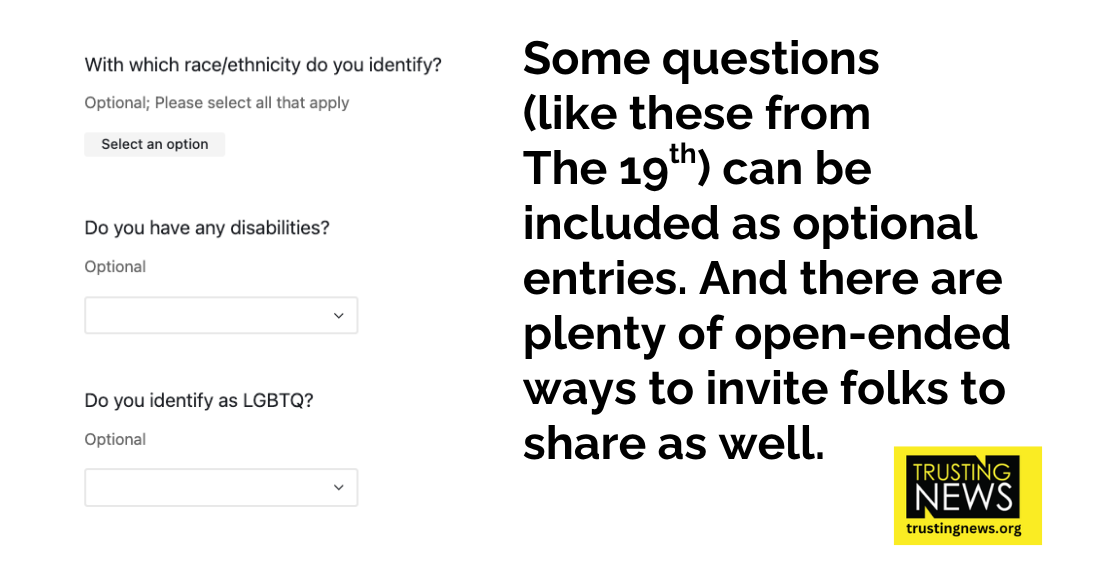
To get back to a real public square, Tom writes, diversity in newsrooms should be ideological and political as well as demographic. (Here’s our Hiring Guide for Dimensions of Difference.)
- How do you know something is true? Bring your receipts
- Yes, you should interview Trump voters (and other answers to questions we’re hearing from journalists)
I’ll end with a quote from one of the smartest editors I’ve worked with: Alison Gerber, who until recently was editor of the Chattanooga Times Free Press:
“My view is that when people stop reading our paper, they’re not going to go to another fact-based, legitimate news organization. They’re probably going to a partisan — maybe even fringe — website somewhere, whether it’s on the right or the left, one that maybe even dabbles in conspiracy theories. Or, best case scenario, [it will be a source that] is very partisan and biased. And I don’t think that that is good for our community. I don’t think it’s good for our country. I think it’s actually an existential threat to our whole society and our whole democracy. And I think my goal is to keep people reading fact-based journalism.”
At Trusting News, we learn how people decide what news to trust and turn that knowledge into actionable strategies for journalists. We train and empower journalists to take responsibility for demonstrating credibility and actively earning trust through transparency and engagement. Learn more about our work, vision and team. Subscribe to our Trust Tips newsletter. Follow us on Twitter, BlueSky and LinkedIn.

Executive Director Joy Mayer (she/her) founded Trusting News in 2016 after a 20-year career in newsrooms and teaching. She lives in Sarasota, Florida, and can be reached at joy@TrustingNews.org.