If you don’t answer basic questions about how you operate, your audience will make their own assumptions — and they’re likely to be inaccurate and unflattering.
Steal this idea to inspire civic action
Want to get this Trust Tips newsletter in your inbox each Tuesday? Subscribe here.There’s a group of people who avoid the news because it leaves them feeling powerless. Some of the Reuters research shows this, and we saw similar themes when we had local journalists investigate news avoidance in their own communities.
This isn’t all that surprising, right? Who wants to learn about all the problems in their community with no way to fix it? But often as journalists, we can be so focused on providing facts and updates to our audience that we can miss the next step in providing relevant, useful information — what people can actually do.
Today we’re pointing to a cool new initiative from Planet Detroit that works to help solve for this.
Planet Detroit’s ‘Civic Action Toolboxes’
Planet Detroit, a nonprofit news outlet focused on climate and public health, has started including “Civic Action Toolboxes” in their stories, helping people connect journalists’ content to direct civic action in the local community.
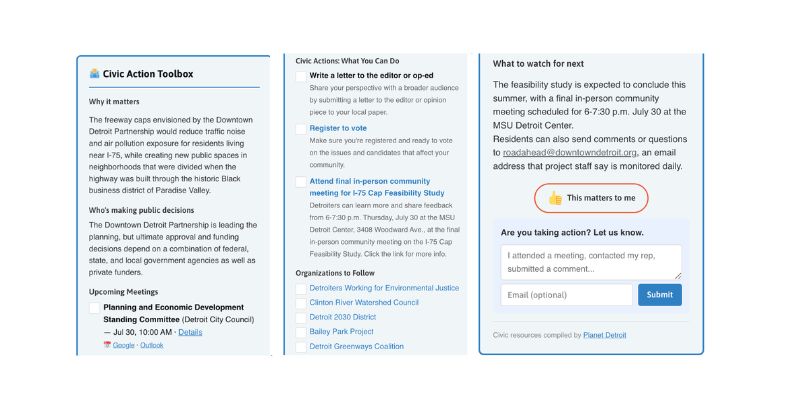
Here’s an example of what this looks like in a story about potential freeway caps. The box includes a blurb explaining how these initiatives may matter to the community, who is making public decisions, a checklist of civic actions readers can take, upcoming city meetings and what to pay attention to next.

Nina Ignaczak, founder and executive editor of Planet Detroit, said one of the motivating factors for the organization to create these toolboxes was that they were getting questions from readers asking how they could act on the issues being covered by their journalists.
“What surprised me is how many readers write back saying they hadn’t known they were allowed to participate at all,” Ignaczak wrote in an email.
They’ve been using these boxes for the past year and a half, and overall the results seem very positive. They’ve had more than 900 people self-report by checking civic actions checkboxes, and 65 readers who wrote in to describe what they did — whether that was attending a meeting, contacting an official or organizing with other people.
And maintaining trust and objectivity is crucial for the team. “The rule that makes this work is that a box shows readers where a decision is being made and never tells them what position to take,” Nina said. “Our reporters and editors write the boxes rather than a separate engagement team, which is the main reason that line has held.”
Nina did note that the way they started off, which was researching and compiling these boxes manually, quickly became unsustainable for their small newsroom of seven: In the first year they were creating these boxes, they were spending 45–60 minutes per story just gathering the information for them. So instead, they built a tool that gathers information from a database of 95 local government bodies and hundreds of community organizations. The editor then reviews the items before publishing.
And the good news is they are making this tool more widely available for other journalists and newsrooms. Nina, along with Ashley Woods Branch — the chief partnerships and revenue officer at Planet Detroit — are 2026 RJI Emerging Technology Fellows. Their fellowship is focused on making the tool work for other newsrooms. If you are interested in piloting the tool, you can sign up here. Beta testing will begin in 2027.
Try this in your upcoming stories
My guess is that you likely do have some of this action-oriented information in your content, like when the next city council meeting is, if and how long public comment may be accepted, community meetings about topics. But too often in traditional journalism, this type of content is buried at the bottom of a story where very few people will see it.
So think about ways you can make this information more accessible and actionable for your audience. I love the idea of rounding up the information in a box (especially an interactive one, like the ones featured today). But you could also highlight it at the top of a story or a newsletter as an editor’s note. You could easily make this the caption on social posts, or even make the whole angle of a story or video about how people can get involved and make their voices heard.
And better yet: Explain how this type of action-oriented coverage is directly related to your mission and goals. Maybe that’s …
- We’ve heard from readers/viewers that they want to know how they can make their voices heard. We want to prioritize content that is helpful and useful to our audience, so we’re sharing different ways you can share your opinion.
- Part of our mission at [insert organization name] is to help provide information that not only informs you but also helps you connect with our community and make your opinion heard.
Another great example of this comes from creator and policy organizer Amber Sherman. Her content is focused on helping people in Memphis navigate public policy and get involved. As part of coaching with Trusting News, she started explaining how her content tied into her overall mission and goals. Here’s some of the language she used:
- “I make content to provide accurate information so you can feel empowered to make decisions” and …
- “I cover these topics to help keep you all in the know and feel more empowered.”
For more ideas on where to put mission- or action-oriented language, see examples in our Transparency Trust Kit.
At Trusting News, we learn how people decide what news to trust and turn that knowledge into actionable strategies for journalists. We train and empower journalists to take responsibility for demonstrating credibility and actively earning trust through transparency and engagement. Learn more about our work, vision and team. Subscribe to our Trust Tips newsletter. Follow us on Twitter, BlueSky and LinkedIn.

Project manager Mollie Muchna (she/her) has spent the last 10 years working in audience and engagement journalism in local newsrooms across the Southwest. She lives in Tucson, Arizona, where she is also an adjunct professor at the University of Arizona’s School of Journalism. She can be reached at mollie@trustingnews.org and on Twitter @molliemuchna.