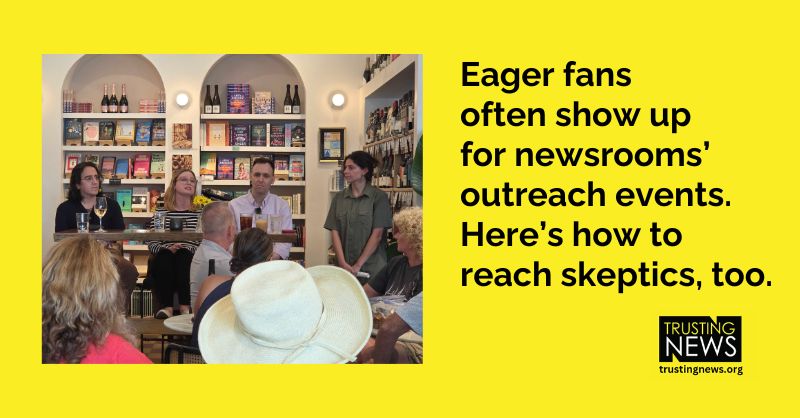
Make the most of your event prep work by taking behind-the-scenes information to a wider audience.
Get more out of your engagement events
Want to get this Trust Tips newsletter in your inbox each Tuesday? Subscribe here.
“That really changed my view on what reporting is these days.”
That’s what my non-journalist friend Jill said after hearing Tampa Bay Times reporters talk about their work at the newspaper’s recent Article Club event, held at a wine bar and bookstore in St. Petersburg. She was absolutely fascinated. She said her previous glimpses behind the scenes of journalism have come only from movies like Spotlight and All the President’s Men, and a bit from conversations in our shared book club, which includes several of us who met in a local newsroom 25 years ago.
Jill enjoyed the chance to learn about records requests, and about the team’s slow, dogged reporting process. The work exposed the secrecy and “creepiness” of government, she said, and made her grateful for the reporters’ efforts. She also loved seeing the people and personalities behind the stories — it reminded her of how local theaters will sometimes bring actors, writers, and subject matter experts on stage for a Q&A after a production.
“So many people think of news as another player in this exploitative game,” she said. Everyone is “trying to get hot takes — going at each other, trying to embarrass each other.”
She said the event made her trust the judgment and process of this specific team of reporters. “I’m now interested in following stories that they do in the future, because now I feel I know them and I know how they’re doing their work.”
She said more exposure to the behind-the-scenes people and processes “would change people’s opinions about newspapers.”
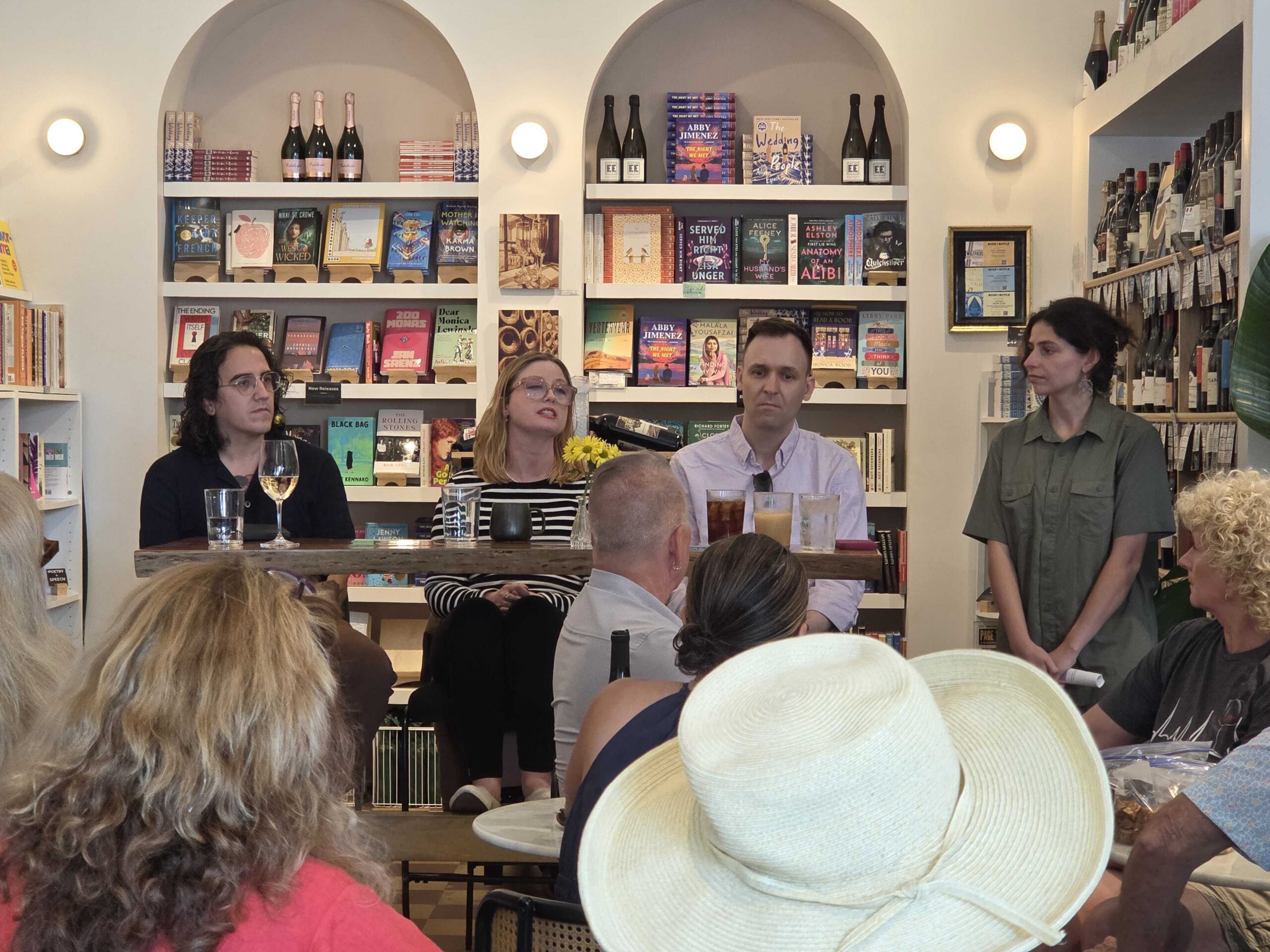
The group gathered for this month’s Article Club was an eager one, ready with questions for Lawrence Mower and Justin Garcia of the Times and Alexandra Glorioso of the Miami Herald about their months-long investigation into the DeSantis administration’s diversion of state funds into efforts to defeat ballot amendments. The event was hosted and moderated by Lauren Peace, who described the initiative here for Nieman Lab.
Attendees asked educated questions about the subject matter, were interested and respectful, and, like JIll, expressed appreciation for the accountability role journalists were playing, and for their hard work. The group felt to me like the audience I would have expected for a Florida event about journalism — heavily skewed older, white, educated, and fans of journalism.
It was so fun for me to see it all up close, then have the chance to debrief with a friend on the drive home. Jill is a pretty typical news consumer, she thinks. She likes podcasts and documentaries and, though she reads a lot of books, really prefers to consume news by listening or watching instead of reading. She values staying informed and always shows up to book club ready to talk about what’s happening in the world, but she also feels a tradeoff between mental health and news consumption and said being informed doesn’t always make her feel very good.
On our team, we’re big fans of news outlets connecting with the public in person and demystifying journalism. Events can be a great way to strengthen connection and build trust, and this event clearly served that purpose.
But we also see a lot of untapped potential to build trust outside of journalists’ existing fans and make the staff’s efforts even more worthwhile. The Article Club event took a lot of effort. At least five journalists attended (and two of them live in Tallahassee, more than four hours away). How could the team make the most of that investment by distributing the material in other ways?
Here are some steps we recommend to bring the types of behind-the-scenes material journalists prep for live events to a wider audience. (They’re also good practice in general, with or without an event strategy.)
Make a list of things you think the audience in the room will be curious about.
What will they find most interesting? That might involve walking them through your process chronologically. But consider focusing on specific situations or challenges that highlight what makes the role of journalism so important and how you go about your jobs with integrity.
Make room for your critics.
Add to your list the misassumptions people might have about your work. What kinds of comments or critiques has the staff gotten about similar work? What do you wish skeptics understood? How is your coverage better, or more responsible, than other media outlets? (We think about this as turning information gaps into opportunities to build trust.) This is important! Don’t just prep for the fans who are most likely to show up to the wine bar event. Prep for the people who aren’t sure if your investigation is yet another example of the “hot takes” Jill is tired of, or even if it’s accurate and accurate. How can you demonstrate your credibility?
Try organizing that information as an FAQ.
An FAQ is a much more useful format than the typical behind-the-scenes columns that sometimes accompany big news projects. Here’s why:
- It can be structured around readers’ information needs rather than as a narrative.
- It’s scannable, giving readers a chance to skip to whatever matches their own curiosity.
- It’s easy to repurpose if it’s already in sections.
- Each question can be its own anchor tag, meaning you can link specifically to that section. (More on the specifics of creating an FAQ are here.)
Once your FAQ is done, it’s so easy to share elsewhere. Each Q&A can be a social card, or the start for a vertical video. It can be a comment under a story or social post.
It can also be a parenthetical within a story, as in … This information is based on detailed records requests that took four months to request and receive. Read more about that process here.
We’ve partnered on research that shows weaving transparency into the story itself is more effective than separating it. That’s one reason why a core principle of ours is taking advantage of attention where you have it. Don’t hope someone will click through to a column, look for your ethics policies, or scroll to the box at the end of a story. Wherever people are encountering information, layer in facts about how that information was gathered and shared.
Speaking of boxes at the end of stories, I asked Jill about them on the drive home. The Tampa Bay Times story she’d read to prep for the Article Club had a gray box at the end with process information — like the thousands of pages of records analyzed, and how the state had declined to comment. It was a good start at transparency but could have been a lot more specific. (Example: How many times was the state given the chance to respond, and in how many ways?)
But Jill would have missed it either way. She said she noticed there was some kind of box at the end but made a snap judgment that it was probably the kind of disclaimers, terms and agreements, thank-yous, or ads that are usually at the bottom of things, so she skipped it.
At Trusting News, we learn how people decide what news to trust and turn that knowledge into actionable strategies for journalists. We train and empower journalists to take responsibility for demonstrating credibility and actively earning trust through transparency and engagement. Learn more about our work, vision and team. Subscribe to our Trust Tips newsletter. Follow us on Twitter, BlueSky and LinkedIn.

Executive Director Joy Mayer (she/her) founded Trusting News in 2016 after a 20-year career in newsrooms and teaching. She lives in Sarasota, Florida, and can be reached at joy@TrustingNews.org.