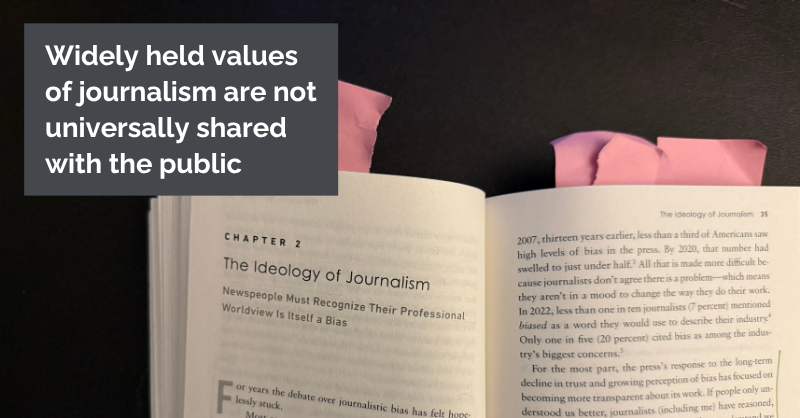
The powerful should be monitored? Society works better when more things are out in the open and transparent? Statements like these feel like common sense to journalists, but our neighbors do not all agree.
Be more aware of your ‘professional ideology’
Want to get this Trust Tips newsletter in your inbox each Tuesday? Subscribe here.
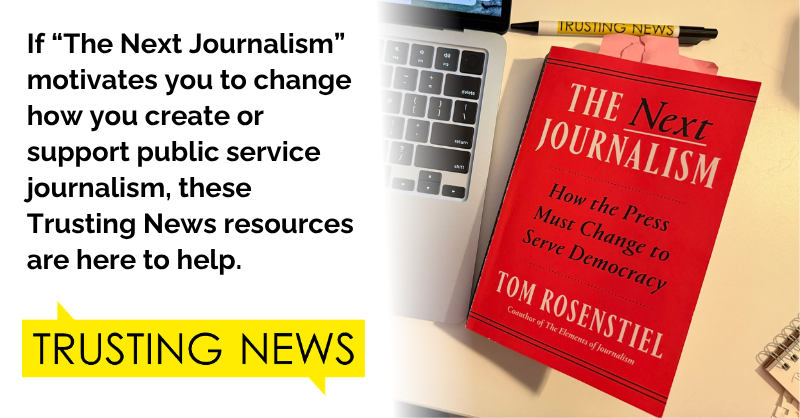
One of the themes from Tom Rosenstiel’s new book “The Next Journalism” is that journalists need to invest in understanding their own biases, not just defending their intention to be fair. That intention is so deeply ingrained in the industry that it’s easy to assume it’s actually happening.
But if we fail to investigate that assumption and fail to get curious about whether we’re succeeding, we’re missing an opportunity to address a key factor in earning trust.
Tom writes that “journalism is a kind of professional ideology — a way of seeing the world — that journalists not only fail to recognize but that separates them from the public in ways journalists do not recognize or understand.”
At Trusting News, we have been talking about how the ways journalists are different from the public — and how those differences show up in coverage — since 2020.
If you’re reading Tom’s book, you’ll notice quite a few overlaps between his work and ours. We pulled them together here: Putting “The Next Journalism” into practice: a reading companion from Trusting News. And register here for our Zoom Q&A with Tom on Tuesday Sept. 29.
Getting curious about how journalists are different
My Nieman Lab prediction for journalism in 2022 was about “being honest about how journalists are different from their communities.” You’ve likely heard us talk in a training or in Trust Tips about how journalists are more likely to be urban, coastal, white, well educated, liberal, and secular than the communities we cover.
Tom adds to the list other factors that are often (though of course not always ) present in the culture of newsrooms and also speak to who chooses to work as a journalist. He writes about things like being pro-military and pro-science, and favoring regulatory solutions to social problems. He also points to a desire to promote diversity, make discourse civil and find humor in the outlandish and the corrupt.
Then he writes about Media Impact Project research he worked on while he was at the American Press Institute (when Trusting News was based there). The study looked how the public feels about five core journalistic values:
- The powerful in society should be monitored.
- The more facts people have, the closer they will come to knowing the truth.
- The way to make society better is to spotlight the problems to be solved.
- It’s important to give the less powerful in society a voice.
- Society works better when more things are out in the open and transparent.
I personally agree with all those statements. And frankly, I think a lot of the people in my life would as well. But only one enjoyed broad support from a majority of Americans (the idea that more facts get us closer to the truth). And only 20 percent of Americans support all five.
Which brings us back to this key point of Tom’s: “A perception gap exists between the public and journalists about what’s needed to make society better.” As a group, journalists are driven by values. In order to provide coverage that is hearable by, resonates with and is useful to the general public, we need to understand how our values are showing up in our work and be willing to make changes. The Media Impact Project research has some concrete suggestions. And so do we.
What you can do
This starts with conversations in the newsroom. Ask questions in morning news meetings about what you might be missing. Ask sources what they’re afraid you might get wrong. Form advisory groups of people who can productively challenge your work. Ask readers to tell you if their perspectives are represented in coverage.
One way we work on this at Trusting News is through a program we created with Eve Pearlman of Spaceship Media called Dimensions of Difference. It’s designed to help newsroom teams assess the makeup of their staff and their personal and collective views, values and limitations. We’ve taken several newsroom teams through an in-person workshop, and we also offer an online Dimensions of Difference Newsroom Guide and remote training offerings.
Here’s a broader look at Trusting News programming and research around bias and pluralism since 2020. I’d love to hear from you: What about this topic feels important to you? What would you push back on? What ideas does it spark?
Dive deeper into “The Next Journalism” and how Trusting News strategies can help you take action: Putting “The Next Journalism” into practice: a reading companion from Trusting News. And register here for our Zoom Q&A with Tom on Tuesday Sept. 29.
At Trusting News, we learn how people decide what news to trust and turn that knowledge into actionable strategies for journalists. We train and empower journalists to take responsibility for demonstrating credibility and actively earning trust through transparency and engagement. Learn more about our work, vision and team. Subscribe to our Trust Tips newsletter. Follow us on Twitter, BlueSky and LinkedIn.
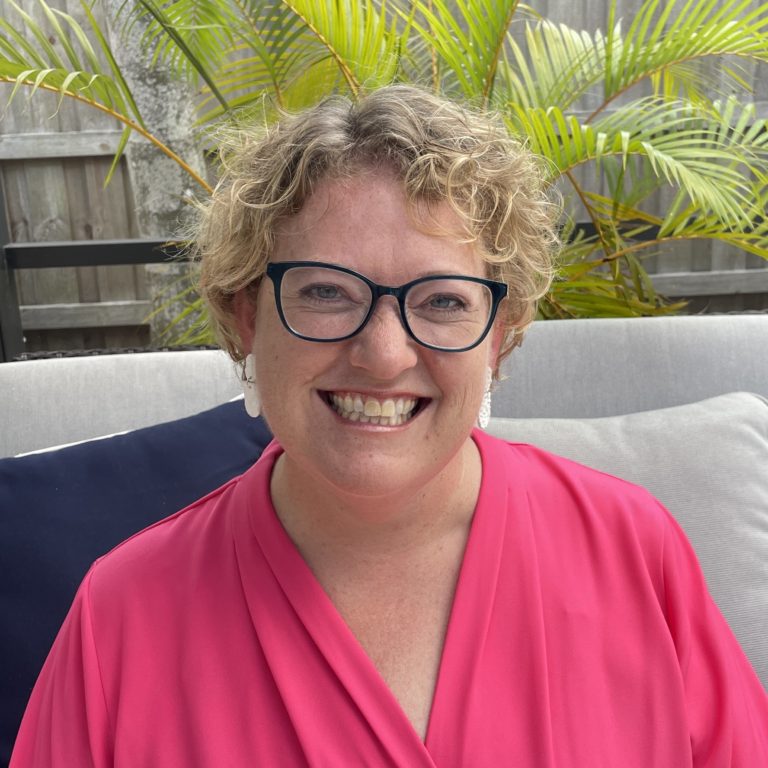
Executive Director Joy Mayer (she/her) founded Trusting News in 2016 after a 20-year career in newsrooms and teaching. She lives in Sarasota, Florida, and can be reached at joy@TrustingNews.org.