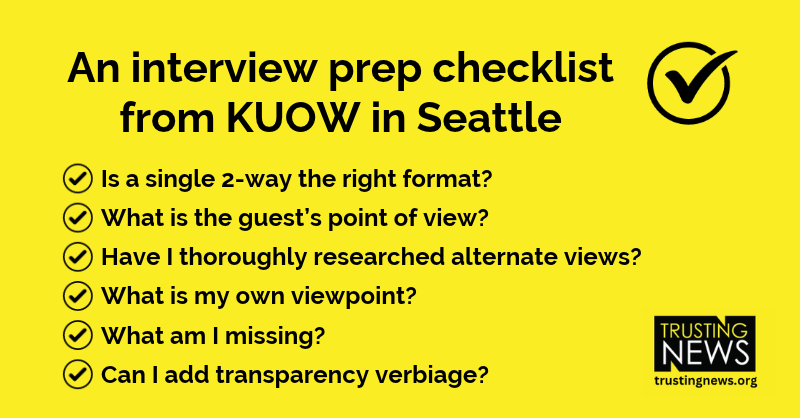
What happens if journalists pause to ask these questions when planning an interview? KUOW in Seattle is finding out.
Assess bias in your interviews with these 6 questions
Want to get this Trust Tips newsletter in your inbox each Tuesday? Subscribe here.
If you talk to frustrated news consumers (which I hope you do!), the subject of bias is likely to come up — some version of “there’s too much opinion in the news these days!”
And if you keep asking questions about those perceptions of bias, you’ll probably hear about more than just overt opinions. You’ll hear about source selection, the way questions are framed, and what journalists accept as true vs. what they challenge. The signs are sometimes subtle, but they’re also often legitimate. Who we are as human beings influences the editorial decisions we make, and we should work to be more aware of those factors.
Let’s look at one good opportunity in the journalistic process to bring in more awareness: when preparing for an interview. How can journalists be mindful of the potential for bias — real or perceived — and try to get in front of it?
How KUOW is checking for bias
That was one of the questions on the mind of Deborah Wang at KUOW when we started working together several months ago. After more than 20 years in the newsroom, Deborah is applying her experience to big picture questions around the quality of KUOW’s journalism. And that includes building trust and reflecting more diverse perspectives.
She started doing content reviews with the teams behind individual shows, and some of the same issues kept coming up, like how they were selecting sources and framing questions and how aggressively they challenged sources’ views.
They also were assessing how effectively they acknowledged dissenting views, or whether they might sometimes be giving the impression that this interview was the definitive take on a complicated topic. After all, journalists hope to be judged on the breadth of our coverage, but the audience typically consumes (and holds us accountable for) single stories, or even tiny snippets.
Sometimes conversations like these point to a need for something simple like referencing other existing coverage. But sometimes they also surface the need for more rigorous self-reflection on what journalists were missing.
Deborah turned her observations into a six-question checklist. It’s designed for host interviews (sometimes called 2-Ways) — lightly edited conversations with a single source. But it applies to more general interview prep as well and is really a chance to interrupt and update a tried-and-true routine.
Here are the six questions KUOW is asking about its host interviews:
- Is a single 2-Way the right format? Is this a subject that is best covered with a single 2-way? For controversial issues especially, will choosing just one guest with a particular point of view come across as biased?
- What is the guest’s point of view? What position are they advocating? What does their organization stand for? Explain this up front so the listener has a chance to understand where they are coming from as they listen.
- Have I thoroughly researched alternate views? Educate yourself on other points of view. This could include asking a guest in the pre-interview or even on air: Who is the smartest person who disagrees with you and what do they say? Ask the guest to respond to the criticism on air or consider interviewing those critics as well.
- What is my own viewpoint? Ask yourself: What is my point of view on this issue? Or is there a collective (team or newsroom) bias on this issue? Could I be leaning into agreement or opposition based on that?
- What am I missing? Are there other viewpoints, experiences, communities, etc. that we are missing?
- Can I add transparency verbiage? How can I communicate to the audience that we are aiming to cover issues comprehensively, especially around controversial subjects? Remind them that not every story will cover every base. Point them to where they can find previous stories and tell them what we plan to do in the future.
Is the checklist being used, and is it helpful?
As always when creating change in culture or routines, adoption of the checklist is uneven. Some colleagues are using it more than others. One team said they don’t look at it often but have infused it into their usual routines, which is a great sign of success!
I asked Deborah for an example of where the questions have been particularly useful, and she told me about a conversation on food safety that wasn’t controversial but that still missed the mark. An expert source had legitimate views to share, but he also came in with an ax to grind. The journalists missed an opportunity to interrogate his views. They also didn’t do enough to acknowledge dissenting perspectives and invite him to respond to them.
A listener could reasonably come to the conclusion that the journalists thought this source’s perspective was a definitive one. Instead, what if the interviewer found the right moment to both ask tougher questions AND build some understanding of the newsroom’s goals and ethics, by saying something like:
There are of course other reasonable ways that our listeners might be looking at this issue, and it’s important that our coverage reflect those diverse perspectives. I wouldn’t be doing my job if I didn’t ask you to respond to this criticism of your position.
Want Trusting News support for your team?
Our coaching with KUOW is a follow-up to a Zoom training Trusting News created for the newsroom. We’ve spent months in conversations about this bias checklist, about transparency, and about their excellent Community Voices project.
We know not all teams have bandwidth or budget for customized training or consulting these days, and we’re happy that most of what we offer the industry is subsidized by philanthropy. But if you DO have the brain space and dollars to support our involvement in your team’s work — or if you support a network of newsrooms you’d like us to work with — please get in touch at joy@TrustingNews.org.
At Trusting News, we learn how people decide what news to trust and turn that knowledge into actionable strategies for journalists. We train and empower journalists to take responsibility for demonstrating credibility and actively earning trust through transparency and engagement. Learn more about our work, vision and team. Subscribe to our Trust Tips newsletter. Follow us on Twitter, BlueSky and LinkedIn.
Executive Director Joy Mayer (she/her) founded Trusting News in 2016 after a 20-year career in newsrooms and teaching. She lives in Sarasota, Florida, and can be reached at joy@TrustingNews.org.