Focus group members indicated that encountering this type of coverage would motivate them to subscribe, become members, or even make financial contributions to mainstream outlets.
New research: Readers prefer transparency, solutions and engagement-fueled journalism
People indicated that encountering this type of coverage would motivate them to subscribe, become members, or even make financial contributions to mainstream outlets.
We have new evidence that not only are news outlets changing their journalism content to be more transparent, solutions focused and engaged with less horserace coverage, but also that audiences prefer this type of content.
We — Drs. Sue Robinson and Joshua Darr — have been working with Trusting News, Solutions Journalism Network, and Hearken for five years to document any impacts that the Democracy SOS/Advancing Democracy training has had in the industry. Two of our multi-method, multi-year studies have now been published in academic journals showing overall change for the good and more nuanced understanding of what works and what does not. The results will be part of a forthcoming book titled The Politics of Local Journalism: Building Democracy Through News Practice (2027, Oxford University Press).
We know journalists wonder whether a training cohort like this is worth their investment of time. Will it lead to meaningful change, and will the public notice and prefer the changed coverage? Those are the questions we set out to answer with these three collaborating organizations.
Fundamentally, this research demonstrates an audience preference for — and willingness to pay for — political news coverage that:
- Demonstrates responsiveness to and engagement with communities
- Frames headlines and stories around solutions, not just problems
- Highlights constructive dialogue and cooperation even on controversial topics
- Uses transparency strategies to explain how a story was produced and signal the intent and integrity behind the work
We’ll explain what we studied and then say more about the public’s response.
Journalism content is changing
The Democracy SOS/Advancing Democracy program trained hundreds of journalists through nine months of training and coaching each year from 2022–2025, interweaving the complementary strategies of the three organizations.
Our first study contains the results of a large-scale content and textual analysis. A portion of these results (from 2018–2022 with fewer of the news outlets) were published in an academic journal article in Journalism & Mass Communication Quarterly in 2025. For the book, though, we added another year of stories with a new cohort of trainees.
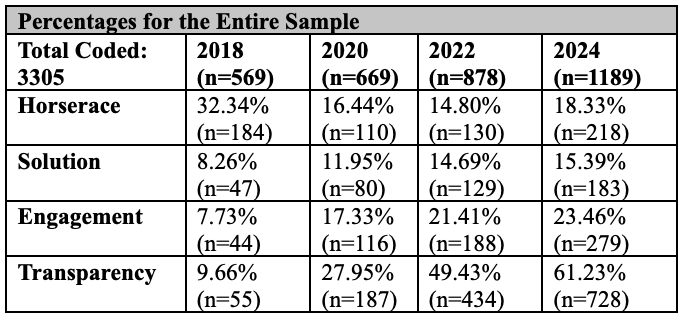
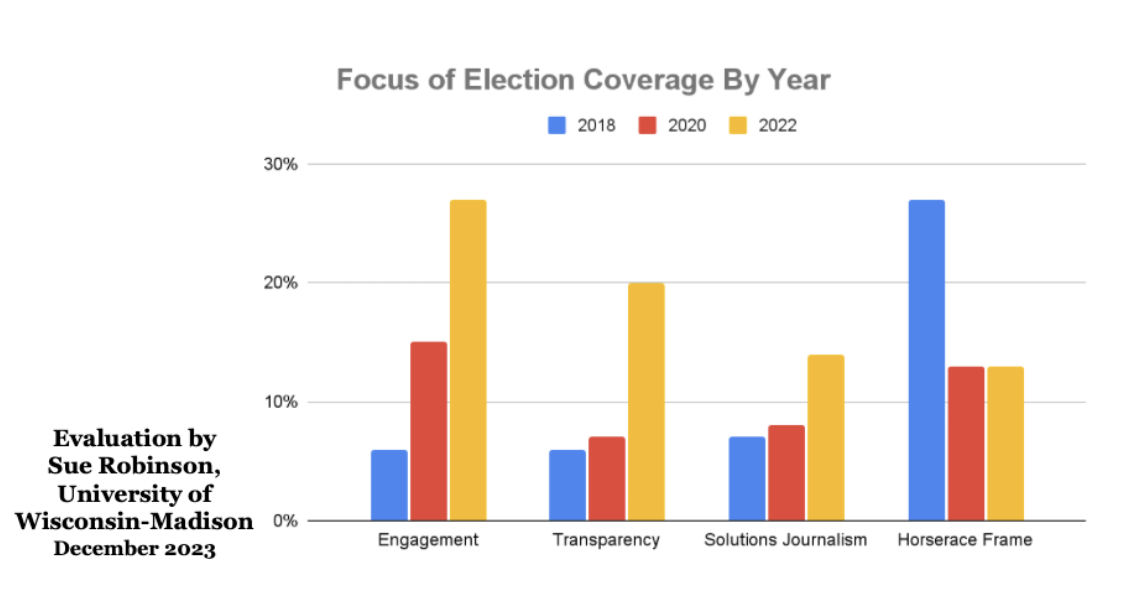
After collecting and coding 3,305 pieces of political content from 28 news outlets from 2018, 2020, 2022 and 2024, we found that the content did significantly transform in that it was more transparent, incorporated more engaged reporting, and offered more solutions while resulting in far fewer horserace frames. Between 2018 and 2024 for our entire sample:
- horserace-framed content decreased from 32% to 18%,
- solutions journalism increased from 8% to 15%,
- engaged reporting increased from about 8% to 24%,
- and transparency soared from 10% of all content to more than 61%.
These huge changes are considered “significant” in research language, meaning that the newsrooms are changing their content more than we would expect them to.
These studies measured the changes on the following concepts (which we called variables):
Horserace:
If the article was primarily about who was winning the race, the fundraising, or the polls, this was framed as “horserace.” These stories tended to have war terminology such as “attacks,” “hits back,” “battleground,” or “game” phrasing like “winning,” “losing,” etc.
Horserace coverage is detrimental to democracy because it can turn elections into popularity contests or set democracy up as something within which people battle as in war. There was a clear decline in horserace coverage from 2018 to 2024 (moving from 32% of all stories to 18%), with most of the decline coming before the training started in 2022 (from 2018 to 2020). This is a welcome larger trendline for the industry!
Transparency:
Our training encouraged transparency that involved reporter bios at the minimum (not just that the reporter covered politics but their experience, education and/or interests) or sidebars that explained the who, what, when, where, why and how of the journalism itself such as how the story came to be, any ethics involved in the reporting, how many sources were consulted, etc.
Over the course of six years, transparency in journalism went from being a rare feature (10% in 2018 for the entire sample) to a central norm in the articles studied (61% in 2024 for the entire sample). As with horserace framing, we can see that transparency’s change was also happening before the training took place. This trend accelerated in their aftermath, perhaps because this was one of the easiest tasks given to the participating journalists.
What forms did transparency take, qualitatively? A number of outlets added paragraphs about their training and the intent behind specific stories. In addition, some trained news outlets created landing sites that gave Q/As or explained their reporting approach to elections coverage. See, for example, WITF’s elections page that continues to be updated. Here, journalists revealed the background work of fact verification and language choices, among other details, demonstrating a commitment to provide media literacy for the populace on a scale not seen before as a nod to the reality that journalists no longer have the blanket trust to report the facts. This evidence indicates they are asking for the trust and earning it through the building of evidence and transparency.
Solutions:
The Solutions Journalism Network outlines four main criteria for solutions stories: focus on a response to a social problem, evidence that it’s working, its limitations along with its strengths, and what insights it holds for a news organization’s audience. We researchers were a bit more liberal with what might be considered a solutions story: If the majority of the article focused on a response to a major problem, then the entire article was coded.
This included, for example, stories about a candidate’s stances that pointed to solutions for more than half the story. Overall, solutions journalism in the entire sample increased from 8% of the content in 2018 to 15% in 2024 with a steady increase through all the years. Many of these stories contained the four “pillars” and, as such, these in-depth and nuanced stories model for communities how we might elevate our political discourse and move away from polarizing tropes that filter down from national landscapes.
Engagement:
If the article mentioned, either in the transparency paragraph or as part of the story itself, that reporters conducted some kind of engagement-specific outreach for the story, we coded it as being “engaged.” This meant any note that journalists interacted with community members in some way such as a feedback request about what to cover, a listener forum, or a survey that the newsroom fielded. Because so much political news today is full of talking heads, politicians and strategists, we also coded stories that quoted 2 or more community members who were not political experts or public figures.
Our trained newsrooms also showed steady increases between 2018 and 2024 for engaged reporting, starting with less than 9% of their stories featuring engagement and ending above 20% for all stories in 2024. Though there were clear increases in engagement from 2018 to 2020 as well, the tests we ran on the study (called chi-squared results) show a significant increase from the time period before the training to the time(s) afterwards. How these news outlets are learning to practice a different kind of engaged journalism directly serves as a panacea to the parallel and conflicting political public sphere dominating discourse nationally.
Audiences prefer engagement, transparency, solutions, more complexity
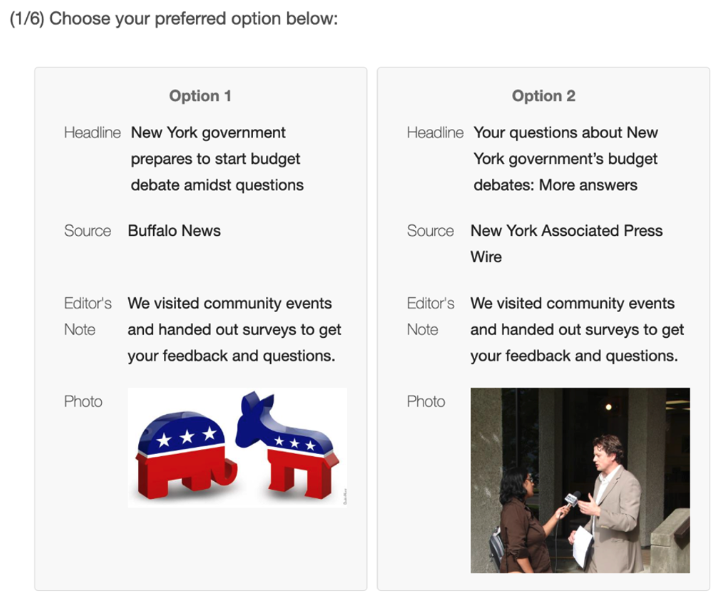
The audience study published Aug. 8, 2026 in the academic journal Political Communication revealed what people thought about this changed content. We took real, published content from newsrooms who participated in the training and showed them to audiences: First, more than 2,100 respondents saw two packages (see the image) of randomized news story features such as headlines or transparency blurbs and chose their preference, allowing us to determine the impact of changed or conventional journalism. These kinds of quantitative tests are called “conjoint experiments.”
Then, the researchers took the content to 7 focus groups with 49 people to nuance the answers from the experiments using qualitative techniques.
The results reveal a clear preference for updated reporting styles, with participants consistently selecting the reframed articles and expressing higher trust in the accompanying news brands. Focus group members indicated that encountering this type of coverage would motivate them to subscribe, become members, or even make financial contributions to mainstream outlets. These audience members told us the following:
- People show a strong preference for any kind of engagement mentioned anywhere in the story, whether as part of headlines (eg “Your questions about [STATE] government’s budget debates: More answers”) or as notes at the end of stories (eg “We visited community events and handed out surveys to get your feedback and questions”). They especially did not like it when headlines or notes mentioned lobbyists or legislators. In addition, audiences felt connections to stories that were about their own identity groups.
- Headlines that mentioned solutions, rather than problems, were chosen repeatedly; for example, the headline “Housing costs remain unaffordable for many in [STATE]” focused on the problem while “Community land trusts can help [STATE] improve housing affordability” captured audience attention better. However, audiences were agnostic about taglines at the end of stories like “This is a solutions-oriented story reported as part of our ongoing yearlong Advancing Democracy Fellowship.” Focus groups loved it when the story emphasized pathways forward — but only if it did not seem like a biased call to action.
- Stories framed with polarizing language were rejected consistently by audiences in both conjoints and focus groups, with strong preferences expressed for evidence of people getting along, being introspective, and offering understanding to “others” despite the controversies present in any topic. For example, the headline ““We’re proud Christians too”: local pro-life and pro-choice congregations meet to discuss abortion” did much better in the conjoints than the headline “Pro-life and pro-choice congregations clash on abortion rights: ‘They should be ashamed to call themselves Christians’.”
- People loved the editor or story notes that detailed how the specific story was reported, whether that was in the story itself or its own content. Focus groups, though, cautioned about revealing reporters’ political persuasions because the audience would assume they were biased. Interestingly, audiences were not as interested in seeing general “pledges” of accuracy and evidence that are so popular now with news organizations. The generic promises were not as effective as the explanations about how and why specific stories were produced.
In these quantitative and qualitative studies, we see that audiences respond to information that makes them feel as if they have agency over their information choices. They liked determining where the information came from. They liked to see that the journalists were not just talking to pundits and politicians, but also “real people” whom they could relate to and learn from. They liked being shown ways to talk about political issues without rancor. They liked not feeling as if the news was talking down to them or making fun of their positions. And, they liked feeling like the information contained hopeful pathways forward.
Although we looked for these specific variables as stand-alone concepts in both the content and audience studies, we do note that these contexts overlap with each other. For example, engaged reporting can only be discerned if the journalists tell audiences about the reporting strategies, which in itself is evidence of transparency. Furthermore, we can only say that these news organizations who participated in these trainings were changing content and that audiences liked it: there was a correlation with the training of course, but we cannot say that the training itself caused the changes. For that, we will be doing additional studies at some point.
We don’t often have the chance to study the impact of training like this over time, to really find out what changes when newsrooms invest in deep, aspirational development. We know it is tough for journalists to invest in changing their practices, and we also know that the industry is hungry for data about what audiences prefer — and what they say will cause them to make financial contributions to newsrooms. Our hope is that this research demonstrates that the investment in more responsive, more transparent, more solutions-focused journalism can be worthwhile.
Research transparency
Note: The researchers received about $40,000 from Solutions Journalism Network’s funders to pay for the data collection of these projects over the course of 5 years. However, the teams maintained independence through myriad ways:
- The teams — and there were about a dozen students all together — employed statistical metrics such as “intercoder reliability” using “Krippendorff’s Alpha” to ensure the classification of variables could be replicated by anyone.
- Those collecting and documenting the raw data did not have interactions with any of the partners.
- All of the studies had to go through several universities’ Institutional Review Board protocols (University of Wisconsin-Madison, Louisiana State University and Syracuse University).
- Industry partners were not allowed to change any findings.
At Trusting News, we learn how people decide what news to trust and turn that knowledge into actionable strategies for journalists. We train and empower journalists to take responsibility for demonstrating credibility and actively earning trust through transparency and engagement. Learn more about our work, vision and team. Subscribe to our Trust Tips newsletter. Follow us on Twitter, BlueSky and LinkedIn.

Sue Robinson
Sue Robinson is a researcher of local news and the Helen Firstbrook Franklin Professor of Journalism with the University of Wisconsin-Madison. She has three books about the industry published, with two more dropping in 2027.

Joshua Darr
Dr. Joshua Darr is a journalism and political science professor at Syracuse University. He is Director and Principal Investigator of the Local NExT Lab, where he partners with local news organization to test their ideas, insights, and innovations.