How often are we clear about all the ways we gave people a chance to go on the record?
Detail how you tried to reach a source — and their response
Want to get this Trust Tips newsletter in your inbox each Tuesday? Subscribe here.
“Calls were not returned.”
“They did not respond to requests for comment.”
“They did not respond by deadline.”
How many of us have used phrases like this? I know I have typed and edited many versions of these sentences, especially when working on the public safety and breaking news beat.
When journalists use phrases like this, we’re assuming that the public will know that we’re operating in good faith. That we’re not being lazy. That we’re working to be fair and evenhanded. That we would, actually, rather have a comment or a statement than include “no comment” in a story.
But unfortunately, we’re often not given the benefit of the doubt as journalists. As we so often talk about at Trusting News, there’s a whole lot of research that shows it’s much more likely people will assume journalists didn’t try very hard — that we contacted someone at the very last minute. Or, worse, that we purposefully excluded a perspective to skew the story.
These ill-founded assumptions are only amplified in the current political atmosphere, where many public officials are actively trying to discredit journalists.
Investing in sharing a counter-narrative about our journalism — and showing what makes it worthy of people’s trust — requires us to be much more transparent about our process and highlight our rigorous reporting. In these situations, that could look like making it clear all the ways we gave people a chance to go on the record — and when appropriate, sharing how they responded.
Here’s how ProPublica did this
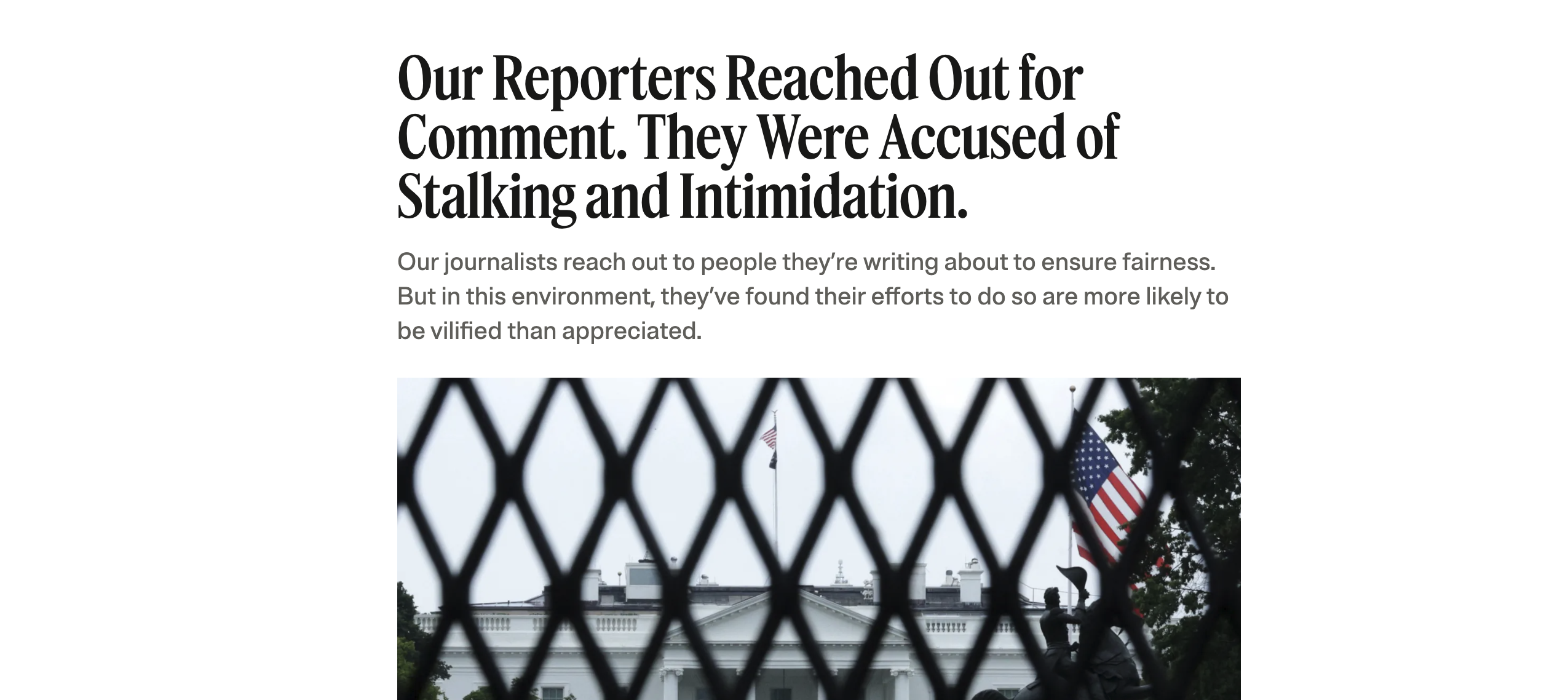
Charles Ornstein, ProPublica’s managing editor, recently wrote a column detailing multiple recent examples of how ProPublica reporters reached out to sources for comment and the sometimes extreme pushback they experienced in doing so.
Ornstein explains how three different journalists, reporting three different stories, tried to contact officials and/or federal departments — detailing who they tried to contact, how they attempted contact them, over what period of time, and how public officials responded.
The column not only successfully highlights their journalists’ meticulous reporting methods, but also paints a picture of the pushback these journalists are facing — and the outlet’s commitment to fair and accurate reporting.

Here’s another recent example from ProPublica reporter Hannah Allam. In a newsletter edition talking about her coverage of Sebastian Gorka, Trump’s counterterrorism czar, she briefly shares how she tried to reach out to Gorka for comment and goes into even more detail explaining the depth of her experience reporting on this topic. It’s a great example of how a newsletter can be a natural place to include first-person transparency and talk through the process of reporting a story.
This works in daily coverage, too
The depth and breadth of the situation ProPublica reporters are facing absolutely called for a longer explanation. But “no comment” happens often, so what can you include in your day-to-day reporting that will show your commitment to fairness and accuracy?
One way to start is by adding more detail about the process. What of the following could you include in your story alongside?
- Who did you try to reach? Did you try to reach out to multiple people?
- Over what period of time?
- Via what methods?
- If you were working under a tight deadline, how did you convey that urgency to your sources?
- How will you continue to seek comment? Will the story be updated later?
- How can you explain how you tried to balance any missing perspectives?
- And especially when covering public officials, how can you remind people that commenting on public affairs they are directly involved in is part of the public service job they signed up for?
Here’s an example of what this could look like.
- Instead of … Calls to (this company or person) were not returned.
- Try something like … Part of our commitment to fair, evenhanded journalism includes inviting people on multiple sides of an issue to respond to how their work and views are described. Read more about that in our editorial policies here (link). We reached out to this person/company via # of phone messages and # of emails that were left over a period of a week, and they were unreturned. We will reach out to them again as our reporting on this topic continues. (Or, even better, we will update this story if they get back to us after publication.)
Other examples
- The San Diego Union-Tribune has a public-facing Fairness Checklist. One of their commitments to the public: “Give subjects ample time to respond, generally speaking, a minimum of 24 hours.”
- When WUSA investigated police practices, the reporter walked viewers through each step of how they tried to get in touch with the D.C. police chief, including how they worked over four months to get him on the record.
Two resources on sourcing
Speaking of sources, we have two really great resources for journalists.
- A Trust Kit on how to explain your sources.
- And a Trust Kit on how to earn trust with your sources.
At Trusting News, we learn how people decide what news to trust and turn that knowledge into actionable strategies for journalists. We train and empower journalists to take responsibility for demonstrating credibility and actively earning trust through transparency and engagement. Learn more about our work, vision and team. Subscribe to our Trust Tips newsletter. Follow us on Twitter, BlueSky and LinkedIn.

Project manager Mollie Muchna (she/her) has spent the last 10 years working in audience and engagement journalism in local newsrooms across the Southwest. She lives in Tucson, Arizona, where she is also an adjunct professor at the University of Arizona’s School of Journalism. She can be reached at mollie@trustingnews.org and on Twitter @molliemuchna.