Explaining language and concepts can make a story legible to and hearable by a wider audience.
Provide on-ramps to terminology describing trans people
Want to get this Trust Tips newsletter in your inbox each Tuesday? Subscribe here.
The words journalists use and the words they explain often send a lot of signals about what they think is already broadly understood. That happens across coverage areas. Does your audience need you to provide definitions for topic-specific terminology, or can you assume they’re all familiar with it?
This has been on my mind as I’ve been training newsrooms across the country on reaching communities that are more politically and geographically diverse. What is common for journalists — what they experience in their own friend groups, neighborhoods, and communities — does not align with what is common for everyone. And we see in research, especially with rural and conservative audiences, that they can tell when journalists don’t notice the gap or are judgmental about it.
And as we head into Pride Month in June, we’re spending two newsletter issues on LGBTQ+ coverage. Next week, we’ll share research results from a listening project we did last spring, where journalists investigated news avoidance of LGBTQ+ communities and coverage. Today, we’re looking at evolving social norms and language related to coverage of trans communities.
An example from a Florida high school
Oviedo Community News recently published a story about the experience of trans high school students. It was written by a high school journalist, and OCN chose to publish the piece after the student’s school would not. (The editor’s note at the top of the piece explains that decision-making and links to deeper explanations about the newsroom’s role and policies. They have a practice of deep transparency, as we’ve written about before.)
I want to highlight a separate important component: a glossary and other contextual information that could serve as an on-ramp to unfamiliar language and ideas. Editor in chief Megan Stokes said those components were all the idea of the student reporter, Lia Miller.
Here’s an excerpt, which is followed in the story by a detailed list of definitions.
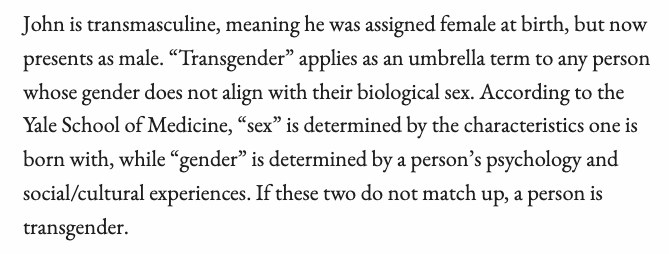
I asked Lia, who was recently named Florida Student Journalist of the Year, why she wanted to include the definitions and who she wanted to reach. She rewarded my simple questions with this incredible explanation of her intent and process:
“Our area has a lot of political diversity, and a lot of students at the school have grown up with varying degrees of exposure to these topics. Many simply have not ever had the opportunity to learn the proper terminology for the transgender community, and by a certain point, it can feel very awkward to ask. I felt like as a journalist, I could provide a helpful service by doing that asking for them: I asked all of the students I interviewed to explain their gender identities and how they viewed the concept of gender in general, and compiled the terms that were actually used out loud by real people and were necessary to understand the rest of the article.
“They also used a lot of slang, which I familiarized myself with, but which can be off-putting for readers not exposed to that. I tried to be as clear as possible with definitions in my article so that the readers could not feel the degree of separation from the community that I think allows people to view them as ‘other’ or turn a blind eye to the challenges they face.”
Now, not everyone will be well served by this content. There are people who have a strong negative reaction to any coverage of what they perceive as “woke” issues. The visibility is what’s offensive to them, and they might not bother to read the specifics or strive for greater understanding. I invite you to set those folks aside for now.
Focus instead on people who are genuinely not educated on words or concepts that they see in journalism. And as a result, they feel like the coverage is not meant for them, and it feels inaccessible.
Is this language still truly unfamiliar to some people?
Personally, my gut reaction is surprise when someone doesn’t understand terminology around sexuality and gender. It’s been 13 years since I first discussed in a newsroom how to incorporate they/them pronouns into coverage. I remember talking at a staff meeting about how to handle the subject/verb agreement. It’s difficult to remember that plenty of people *still* haven’t had a discussion like that one.
A nonprofit leader told me recently about a conversation that his staff (based in a large left-leaning city) led with people from across their state. Participants were asked to introduce themselves to the group and include their pronouns. When it got to one gentleman who’d traveled in from a small community, he said something like: I’m sorry, but I’m confused about what you’re asking me to do. The staff’s sense was that he was answering in good faith — not pushing back, just genuinely not up to speed.
It might feel inconceivable to you that someone paying attention in today’s world would not have been asked to identify their pronouns. And that might be the case for your entire target audience. If you know who you serve, and you’re confident you’re meeting them where they are, that’s great. (Also, we hope you’re sufficiently on the record about who you aim to reach, and also the lens through which you practice journalism.)
But what if that’s not the case? What if people tune out from your coverage because it leaves them more confused, not more informed? What if you miss an opportunity to both be useful to them and to expose them to new ideas? It’s worth at least having a conversation about who you might be leaving out.
Tre’vell Anderson, executive director of the Trans Journalists Association, did a sensitivity read of this piece for me, and I’m so appreciative of their thoughtful observations. They said it’s important to remember that the majority of people are still learning about trans communities — and media are a primary way they learn. Journalists should prioritize audience reception and understanding in our reporting,
“Reporting on trans communities alone is not enough,” Tre’vell wrote in a comment on a draft of this piece. “Making sure the audience has the info it needs to be able to fully understand those they’re reading about is win-win-win reporting.”
And they laid out this vision for what’s possible: “Trans people are accurately covered and reflected in media. Audiences learn truths about their neighbors. Journalists simultaneously build and restore community trust in the process.”
Consider taking these steps:
- Look around your team to see whose background or network could help you broadly evaluate what might seem typical to people across your complex, diverse target audience.
- Build a newsroom culture that values dissent, and encourage staff members to weigh in on each other’s stories.
- Try asking these questions in your morning meetings or story pitches — questions like “will this story be hearable by a broad audience?”
- Hire trans journalists. If that’s a gap you can’t fill, consider contracting with a trans journalist for freelancing, story shaping, or sensitivity reads.
- Make use of the Trans Journalists Association’s Stylebook and Coverage Guide, along with their Workplace Resources Guide.
Also, please be mindful that these questions resonate differently with people across your team. They’ll be deeply personal to some, and it’s crucial that the conversations not turn people’s identities into a cultural debate. Also, trans staffers should not be burdened with leading or contributing to these newsroom efforts. Inviting a broader audience into journalism — what Tre’vell referred to as “audience legibility” — is important across beats and audience segments, and is ongoing work the whole team should embrace.
Thank you to these folks for giving useful feedback and input on this issue:
- Tre’vell Anderson, executive director of the Trans Journalists Association
- Alex Cooper from our Journalist Advisory Committee
- Patrick Johnson, one of our partner researchers
How has this shown up in your work?
Where have you worked to improve audience legibility of your journalism by including context, definitions or other on-ramps? And how would the ideas suggested here be received in your newsroom, or by your audience? Let us know by replying to this email. We’ll keep any observations you send us private unless we get your permission to share.
Thanks for reading!
Joy Mayer, Trusting News executive director
May 12, 2026
At Trusting News, we learn how people decide what news to trust and turn that knowledge into actionable strategies for journalists. We train and empower journalists to take responsibility for demonstrating credibility and actively earning trust through transparency and engagement. Learn more about our work, vision and team. Subscribe to our Trust Tips newsletter. Follow us on Twitter, BlueSky and LinkedIn.
Executive Director Joy Mayer (she/her) founded Trusting News in 2016 after a 20-year career in newsrooms and teaching. She lives in Sarasota, Florida, and can be reached at joy@TrustingNews.org.