Take Hank Green’s backlash as a warning that not disclosing your use of AI can cause more than good.
Creator’s AI controversy is a reminder to talk openly
You may have seen the story circling last week about popular science and education content creator Hank Green sparking controversy over his use of AI.
After publishing a video where fans thought he was reading from an AI conversation (which was disputed by Green), Green did share publicly that he does use generative AI at times to help with research, which triggered quite a bit of backlash among his millions of fans.
Now we’ll pause and say: At Trusting News, we won’t make an argument for or against using technology in your coverage. We don’t know what’s best for you or your audience.
But what we WILL argue for is clear disclosures around how and if you use AI. (And yes, this applies even to those of you who DON’T use AI and are against using AI.)
Let us explain.
What we know about people’s perceptions of AI
My colleague Lynn Walsh has spent the last few years investing in research to understand what people think of AI use in the news and what journalists can do to earn, not lose, trust with new technology.
Two important data points to dwell on:
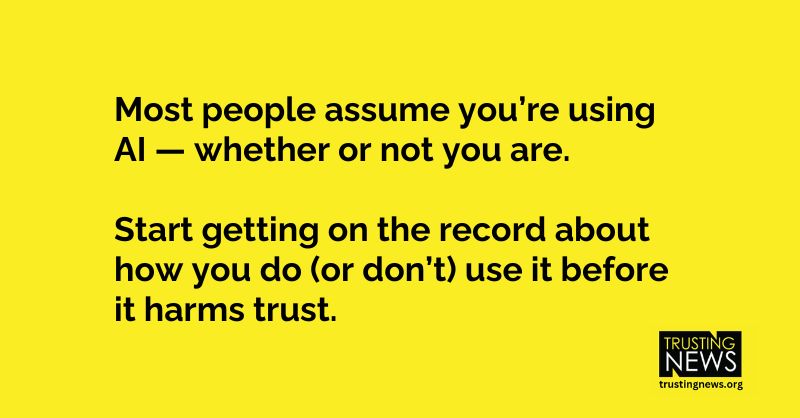
- Much of the public already assumes journalists are using AI, whether or not they are. This actually comes from research from the Reuters Institute, but it’s important to dwell on the fact that whether or not it’s true for you, many people will likely assume you’re using AI to create content. (We’re also seeing more and more people being falsely accused of using AI to create content and in their journalism — it happened just last week to creator journalist Kat Tenbarge.)
- We found in our research that 94% of people want journalists to disclose their use of AI — even if they disagree with the use of AI or it makes people less trusting of the news itself.
While our new research has found that people are getting more comfortable with journalists using AI, they’re really only comfortable when journalists are clearly communicating what guardrails are in place governing their use of AI. In a recent survey, we found that 72% of respondents said journalists should only use AI if they have guardrails in place.
How to avoid AI drama (even if you *don’t* use AI)
If most people think journalists are using AI, then that means journalists should be getting on the record and regularly disclosing how they do — or don’t — use AI.
One way to do this is by creating an AI use policy — we have a handy worksheet that walks you through the step-by-step process of writing one.
These should be a living document where you clearly lay out how you will or won’t use AI. If a “policy” feels too rigid, you can also consider less formal ways to share your process and thinking around AI, like writing a column, recording a video or including it in an FAQ about your coverage. You could use language like “we’re asking questions” or “we’re exploring.” One option is using language like “we typically” or “we won’t usually” rather than “we always” or “we never”.
Now I’ll note that Green’s company does have an AI policy dated back to 2023, which he linked to in an explanation after the fact. It’s a good reminder that a policy itself isn’t enough.
If you use AI to help create your content, you should be disclosing that in day-to-day coverage where people will actually see it. And you should be disclosing it in a way that people can actually understand: What tools are you using? What is it helping you do? What is your process for fact-checking and reviewing the information?
We have another worksheet here that walks you through the step-by-step process of writing a disclosure, based on best practices from our research. And if you want to see what all this actually looks like in content, we have loads of newsroom examples and additional support in our AI Trust Kit.
What does your audience think about all this? Another quick note — if you plan to use AI in your content, we highly recommend you start by asking your audience what they think of AI. If we’re here to serve our audience, we should first understand what questions they have. We have a survey you can copy and use (this link will prompt you to make a copy).
At Trusting News, we learn how people decide what news to trust and turn that knowledge into actionable strategies for journalists. We train and empower journalists to take responsibility for demonstrating credibility and actively earning trust through transparency and engagement. Learn more about our work, vision and team. Subscribe to our Trust Tips newsletter. Follow us on Twitter, BlueSky and LinkedIn.

Project manager Mollie Muchna (she/her) has spent the last 10 years working in audience and engagement journalism in local newsrooms across the Southwest. She lives in Tucson, Arizona, where she is also an adjunct professor at the University of Arizona’s School of Journalism. She can be reached at mollie@trustingnews.org and on Twitter @molliemuchna.