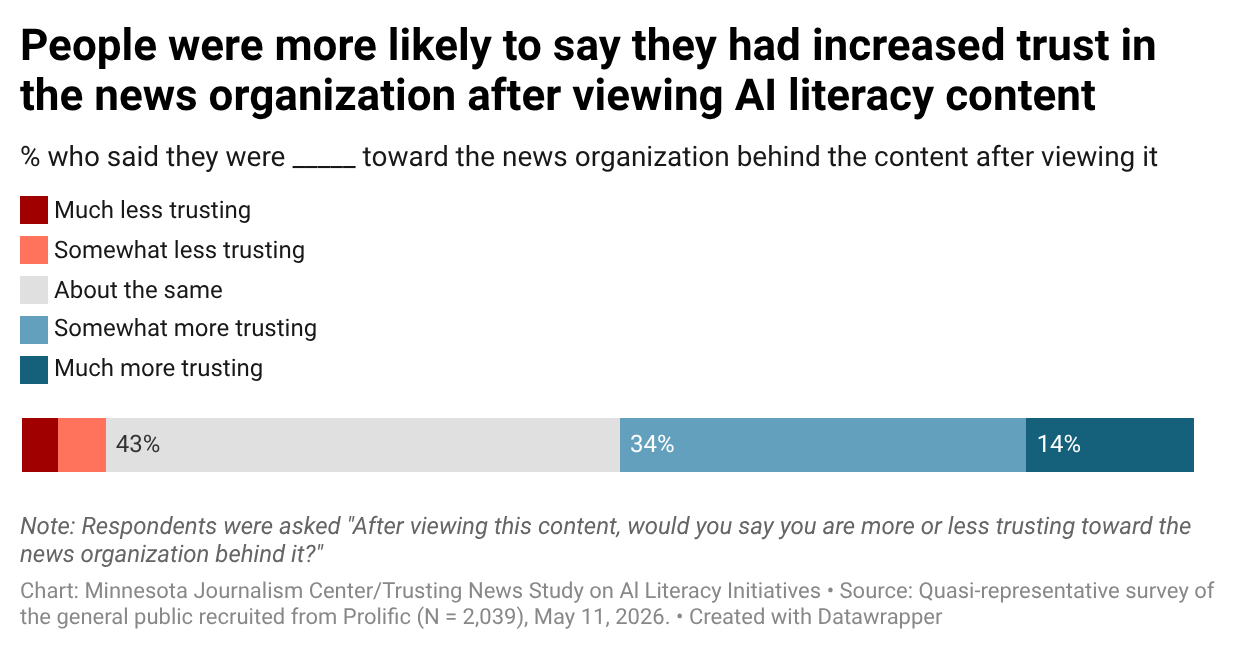
People may be growing more comfortable with AI in journalism, but they’re not asking newsrooms to move faster. They’re asking newsrooms to be more intentional.
Explain how you use (or don’t use) AI
Want to get this Trust Tips newsletter in your inbox each Tuesday? Subscribe here.
Audiences are becoming more comfortable with journalists using AI, but they still expect news organizations to establish clear boundaries around how it’s used.
Across our recent research, respondents consistently told us that transparency and ethical standards matter. While audiences appreciate AI literacy efforts that help them better understand emerging technology, they also want newsrooms to communicate the guardrails guiding their use of AI.
Audiences continue to expect newsrooms to establish clear policies and ethical standards around AI use. Around 20% of respondents from our most recent AI research surveys said, “news organizations should never use AI under any circumstances.” Most respondents in both surveys said news organizations “should only use AI if they establish clear ethical guidelines and policies around its use.”
In the last year, our research has shown that more news consumers are moving away from the belief that newsrooms should never use AI. Instead, they are becoming more comfortable with journalists using AI IF they establish clear and ethical guidelines around its use.
In early 2025, when we asked news consumers this same question, 30% said AI should “never be used under any circumstances,” and more than 60% said news organizations “should only use AI if they establish clear ethical guidelines and policies around its use.” According to our new research, 72% of respondents in the representative sample said newsrooms should only use AI if they have those guardrails in place.
People may be growing more comfortable with AI in journalism, but they’re not asking newsrooms to move faster. They’re asking newsrooms to be more intentional.
Newsroom Inspiration: Conecta Arizona
One newsroom putting these expectations into practice is Conecta Arizona. The newsroom participated in our recent AI Literacy cohort and used the Spanish-language Trusting News AI Worksheet to create a public-facing AI use policy.
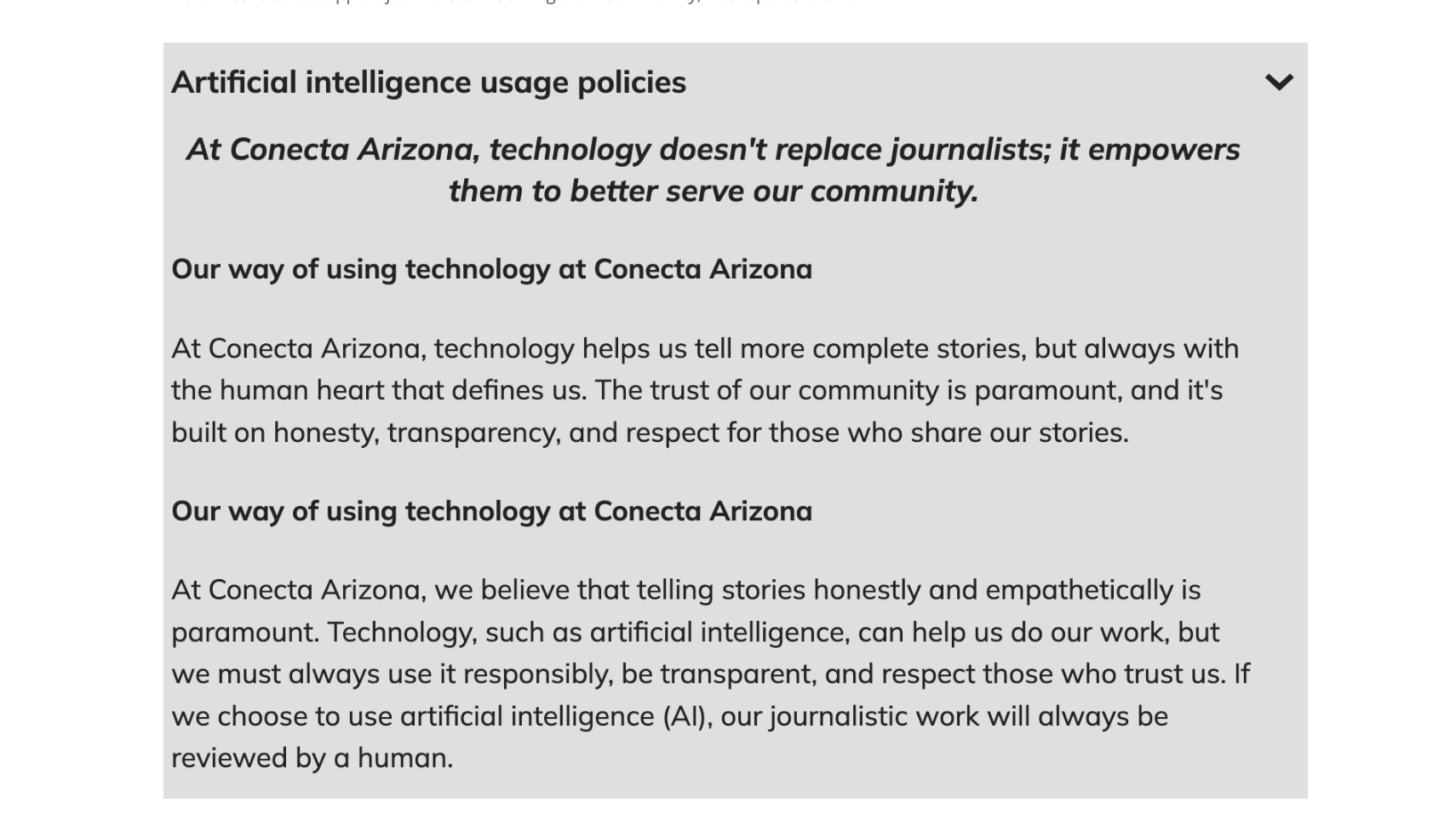
Their AI use policy is linked at the bottom of the “Who We Are” page on their website and opens with a clear explanation: technology and AI are intended to support journalists in serving their community, not replace them.
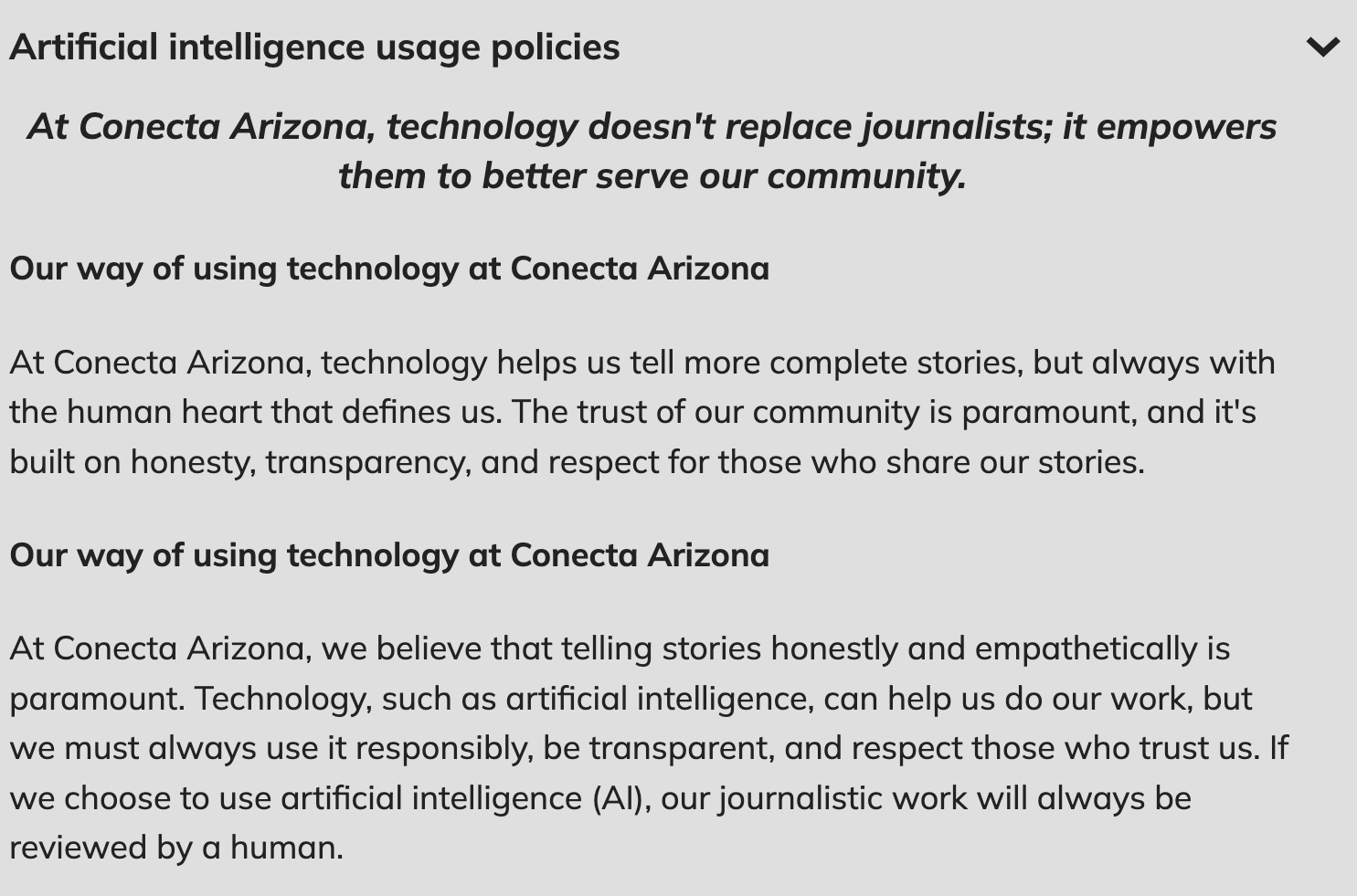
The policy then outlines what audiences can expect when technology is used in the newsroom. Conecta Arizona explains that:
- They will be transparent about when technology is used.
- Human journalists will review and verify information.
- AI and other tools are intended to assist reporting, not determine editorial priorities, like story focus or tone.
- Their approach will continue evolving, and the policy will be reviewed and updated over time.
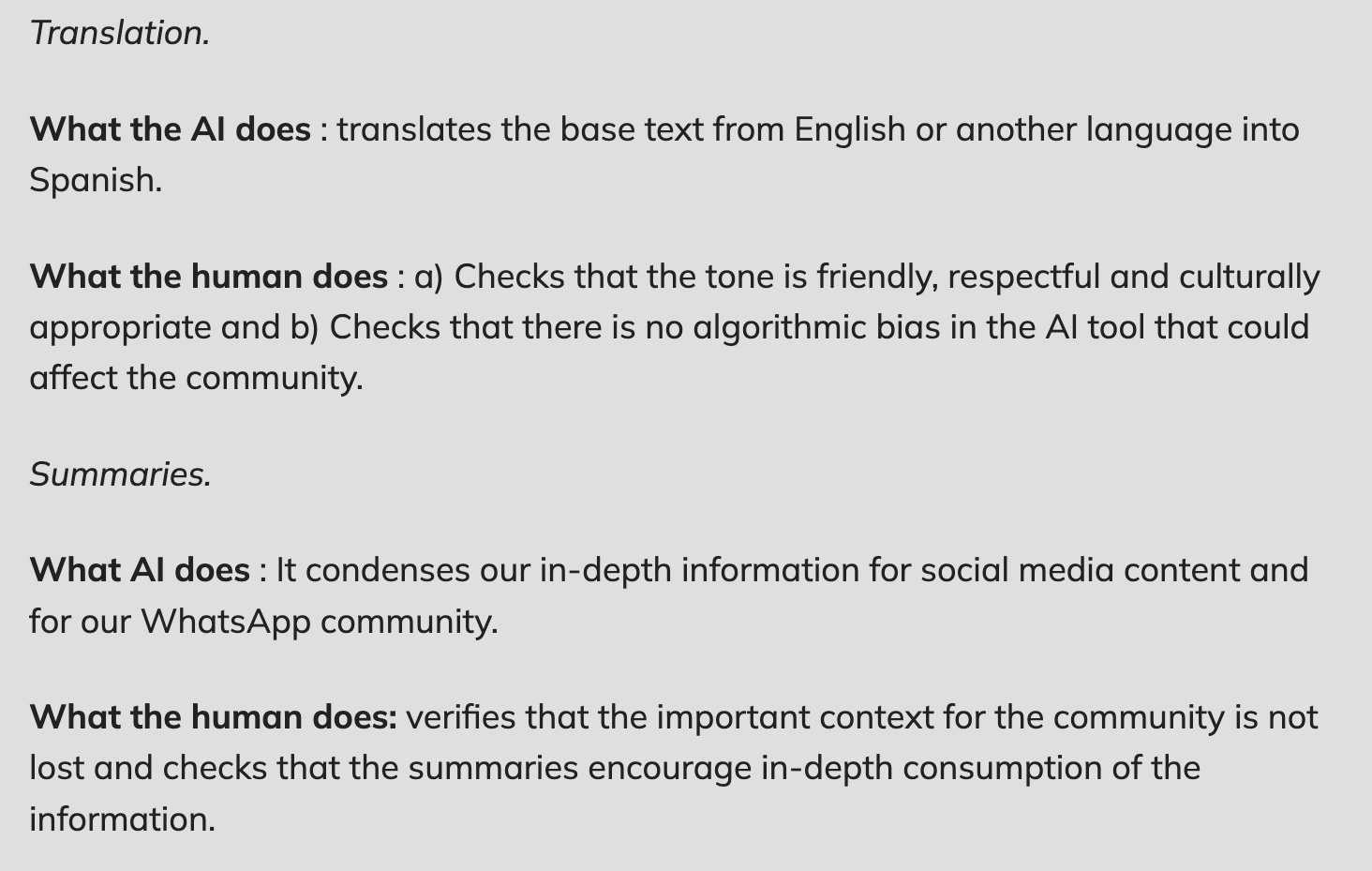
What stands out most is how specific the policy is. Rather than simply saying “we use AI,” Conecta Arizona explains exactly where technology fits into the journalism process. The policy describes current uses of AI for research, analysis, multimedia production and translation. It also distinguishes between the role technology plays and the responsibilities that remain with human journalists.
These explanations help audiences understand not just that AI is being used, but how it is being used and where the human in the loop takes place.
Use our worksheets (English and now in Spanish) to explain your use of AI
All newsrooms should get on the record about how they are (or are not) using AI. One way to do that is in an AI use policy. At Trusting News, we believe your AI policy should be a living document that changes as your use of the technology evolves. If your newsroom is wary of publishing new policies, or if the approval process would be cumbersome, consider other ways to get this information to your audience.
An editor’s column or an FAQ can be a less formal way to share your process. Picture a headline like “How our newsroom is exploring AI in our work.” Use language like “we’re asking questions” or “we’re exploring.” Say “we typically” or “we won’t usually” rather than “we always” or “we never.”
That type of transparency models experimentation and evolution and can demonstrate thoughtfulness and care. Don’t let the wait for a formal process get in the way of your public’s understanding of — and trust in — your use of AI.
Use this Trusting News AI Worksheet (we now have a Spanish-language Trusting News AI Worksheet too) to create an AI use policy based in experimentation and user trust. Get inspired and view examples of newsroom AI use policies in this example database.
And if you’re not using AI in your news content, tell your audience why. Indiegraph has some sample language and a fill-in-the-blank tool to make explaining why you are not using AI easy. Check it out here.
Use our other AI transparency/disclosure and AI literacy resources
Use our transparency and disclosure resources in the Trusting News AI Trust Kit. It includes:
- A worksheet to create an AI use policy (or create one in Spanish).
- A worksheet to create in-story AI use disclosures.
- Sample language to copy/paste into AI use disclosures and policies.
- Newsroom examples of AI policies, AI use disclosures and other AI transparency initiatives.
We also have a new AI Literacy Trust Kit to help you share AI literacy content. In the kit you will find:
- A survey to ask your audience what they want to know, what they are worried about, what formats information is the most helpful, etc.
- AI literacy content we asked the public about. We have created: Social card templates; Social video scripts; An AI literacy quiz
- How to host an AI literacy event. Newsrooms found that hosting events focused on how AI works and how newsrooms use AI can build trust with their audience. Find out more about these events and sample agendas to host your own.
At Trusting News, we learn how people decide what news to trust and turn that knowledge into actionable strategies for journalists. We train and empower journalists to take responsibility for demonstrating credibility and actively earning trust through transparency and engagement. Learn more about our work, vision and team. Subscribe to our Trust Tips newsletter. Follow us on Twitter, BlueSky and LinkedIn.

Assistant director Lynn Walsh (she/her) is an Emmy award-winning journalist who has worked in investigative journalism at the national level and locally in California, Ohio, Texas and Florida. She is the former Ethics Chair for the Society of Professional Journalists and a past national president for the organization. Based in San Diego, Lynn is also an adjunct professor and freelance journalist. She can be reached at lynn@TrustingNews.org and on Twitter @lwalsh.