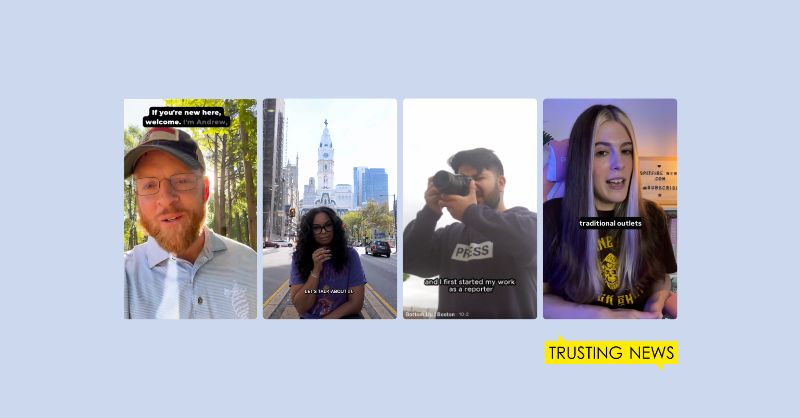
Throughout this 5-month program, creators will get individualized training to test different ways to demonstrate their credibility to their audiences.
Apply now: Creator journalists, get $4,000 to test transparency with your audience
Want to get this Trust Tips newsletter in your inbox each Tuesday? Subscribe here.
Trusting News is thrilled to open applications for a program aimed at helping creator journalists test how they can demonstrate credibility to their audience.
Throughout this five-month program, creator journalists will experiment with ways to signal credibility to their audience. The strategies will cover topics such as who the journalists are, why they are credible, and the ethics and integrity that drive their work. Creators will be coached by Trusting News and gain access to the support and expertise of the Project C community.
Then, alongside a team of researchers, we will gather data about how audiences respond to better understand how creators can effectively demonstrate credibility and build trust with their audience.
Why we are doing this: We’ve been studying trust in the news for 10 years, and we have learned a lot about how journalists can signal their credibility to the public. But we haven’t yet studied how those signals are changing in the creator ecosystem. Credible creator journalists are an important part of local information climates. However, more influencers, creators and news sources emerge online each day — and not all of these informers have the goal of sharing responsible, accurate information with their communities. It is increasingly difficult for people to decipher if what they’re seeing online is actually true, and if it is made with their best interests in mind.
That’s why it’s crucial for credible creator journalists to not only prioritize sharing news in a responsible, ethical way, but also to get clear about what makes them trustworthy. Our ultimate goal is to make it easier for everyday news consumers to find and access credible news while helping creator journalists deepen the level of trust and engagement they have with their audiences.
That is true across all content topics and types. For this project, we’re focusing on topics that intersect with often-fraught political or social issues — topics about which is can be especially difficult to navigate information and determine credibility. (More on how we’re thinking about that is below.)
Who we are working with: We’re working alongside a team of researchers across two universities: Benjamin Toff at the University of Minnesota; and Cydney Grannan and Ariel Hasell at the University of Michigan. Liz Kelly Nelson, Project C, is an acting consultant and partner on this project. This program is made possible thanks to funding from the Vesta Foundry and the Alliance for Trust in Media.
The program will run from early August through January. Interested? Apply here by 11:59 p.m. PT Friday, July 10. We don’t want to waste your time. Please read the program requirements below before applying! If you have questions, reach out to Mollie Muchna at mollie@trustingnews.org.
********
Who can apply:
- We’re selecting up to 10 creator journalists in the United States (sorry, we’re not able to accept international creators for this program).
- We’re primarily seeking out creators who create short-form videos and share those on social platforms (TikTok, Instagram, YouTube shorts)
- We’re looking for a mix of creators focused on local news or national news.
- Because of the small focus of this program, we’re looking for creators whose coverage intersects with political or social issues that might involve high levels of distrust or skepticism. But think broadly here — healthcare, education, business, food, and lifestyle topics can at times touch on trust, even if politics isn’t your main focus.
- We welcome creators who do either original reporting or content aggregation.
- You do not need to have a traditional journalism background! In fact, we encourage creators of all types of backgrounds to apply.
- We are looking for a diverse group across topics, geography, race/ethnicity and target audience.
Participating creators will:
- Create 8 pieces of content that include transparency language about how you operate and why you do what you do (2x a month for four months, for a total of 8 videos). Some of this content will be totally focused on transparency elements, while other times you will just be adding a few sentences to already-planned content. Note: For some of this content we’ll ask you produce two drafts of videos — one like you normally would cover it and another that includes transparency elements. You’ll have the help and guidance of Trusting News staff and university researchers to draft scripts for this content.
- Meet approximately two times a month for group trainings, cohort calls, or one-on-one coaching sessions.
- Collect and share with us audience data. Track metrics of how transparency content performs and how that compares to your baseline metrics. Attach short audience surveys to transparency content to gather data on how audiences respond. Note: Data from the program will be shared publicly in aggregate. We will not share journalists’ specific metrics or audience responses without permission. Read more about how we handle data privacy here.
- Talk publicly to your audience about your participation and disclose that you’re receiving money for participating in the program (we’ll have sample language and help you write and share this).
- Engage with Trusting News staff and research partners to reflect on the experience.
- Receive $4,000 for completion of the program.
- Gain one year of free membership to the Project C community
You’re a good fit if you:
- Publish original content at least once a week.
- Are geographically located within the US and cover news within the US.
- Cover trust-related political or social issues (see explanation above).
- Publish short-form video on social media, even if it’s a secondary format for you. For example, if your main audience is a newsletter audience but you also publish YouTube shorts, that works for us, even if the videos reach a smaller audience.
- Have a growing, engaged audience. Audience size matters less than being able to demonstrate a deeply engaged audience that has been growing over time.
- Are excited to test adding transparency to your content. You should be eager to talk about who you are, your mission, your goals and your process for reporting.
- Care deeply about people having access to good, accurate, fact-based information.
- Are willing to share analytics related to these posts, including reach, engagement, views, comments, DM content and themes, etc.
- Are willing to share research surveys with your audience on your platform.
What we’ll test:
We’ll test these as standalone content and also as elements embedded within already-planned content.
- Disclosures around funding. Explaining how you make money and what your business model is.
- Explaining who you are and your mission. Talk about your credentials, background, motivation, mission and goals for your coverage.
- Explaining how you source content, whether first-hand reporting or aggregated, and how you know sources are trustworthy.
- Talking about ethics. This includes how you work to be independent, or your specific lens or point of view.
Other good-to-know info:
- Full payment is dependent on creators completing all set expectations.
- Creators will own all of the content they produce. As part of the study, researchers will use some of the content for their controlled experiments. Trusting News will also share examples on its platforms and in industry trainings.
At Trusting News, we learn how people decide what news to trust and turn that knowledge into actionable strategies for journalists. We train and empower journalists to take responsibility for demonstrating credibility and actively earning trust through transparency and engagement. Learn more about our work, vision and team. Subscribe to our Trust Tips newsletter. Follow us on Twitter, BlueSky and LinkedIn.
Project manager Mollie Muchna (she/her) has spent the last 10 years working in audience and engagement journalism in local newsrooms across the Southwest. She lives in Tucson, Arizona, where she is also an adjunct professor at the University of Arizona’s School of Journalism. She can be reached at mollie@trustingnews.org and on Twitter @molliemuchna.