If our goal is to be a public service, what better way to be of service than by directly helping our audience get smarter about their news consumption — both of our own products and of others.
Describe a healthy local news diet (maybe for Local News Day next week!)
Want to get this Trust Tips newsletter in your inbox each Tuesday? Subscribe here.
How often have you wished people were more conscientious about the news they consumed? That they had more robust, diverse news diets? And, quite frankly, they were more diligent about ensuring their information comes from sources that operate with ethics and an intent to inform?
Those wishes are all absolutely valid. But crafting a healthy news diet isn’t easy, especially in today’s overwhelming information landscape.
What if, as journalists, we saw this as not just a frustration but as an opportunity? If our goal is to be a public service, what better way to be of service than by directly helping our audience get smarter about their news consumption — both of our own products and of others.
Local News Day — a national day of action to connect people with trusted local news — is coming up on April 9, and we think it could be a great excuse to do exactly this. You could use the day as a reason to not only help people connect with you as a trusted news source, but also point people to other credible news sources and give practical tips for how people can manage a healthy relationship with the news.
In today’s newsletter, we suggest some ideas (and sample social media posts) for how you can do this.
Tips to help your audience navigate news
Modeling a healthy news diet for your audience could absolutely look like highlighting different news sources as a way to help people find valuable content, beyond just your own.
It could also look like sharing tips and advice for how to realistically manage the news. Take inspiration from this recent article by Justin Bank, where he offers advice on shaping your algorithm for the internet you want, or this example from Cascade PBS, where they share tips for cultivating a healthier news diet. Both are full of small, practical actions people can take to better navigate the information ecosystem around them.
When addressing this with your audience, you could:
- Talk about how to manage alerts and recommend specific products (of yours and others) that help people stay informed without being overwhelmed.
- Remind people it’s OK to step away sometimes and that news breaks are normal (I love this example from Jessica Yellin of News Not Noise.)
- Empathize that the news is indeed overwhelming and depressing, and acknowledge any ways you try to account for that in your reporting or team. (Here’s another great example from Ashlyn Limpori-Russie, journalist behind AskAshlyn.)
Social posts you can copy and use
Here are some suggestions of what these types of posts could look like — feel free to copy and use this language verbatim or make any edits.
We suggest recommending specific sources of information, especially for things that are different from what you offer. This could come from a unified brand voice, or it could by way of recommendations from specific staff members. (To follow the weather or traffic, we go here. To find out about fun family weekend events, Sarah turns to this site. To keep up with public safety issues and court cases, our longtime news editor goes here. For feature stories about people and organizations making a difference in the community, our audience producer turns here.)
Social media is a natural place to share information, but you could absolutely also share it in a news story, in a newsletter or on air — anywhere you talk to your audience.
Example: Pointing people to other trusted sources
We know trying to keep up with the news often feels overwhelming and exhausting. Plus, it can be hard to know who is actually sharing accurate, trustworthy information. As journalists at XXX, our goal is to help inform you about what’s happening in our community. But we can’t cover everything, and we’re also here to help you identify OTHER credible information sources.
As partners of Local News Day, we’re sharing some places where our team turns for trusted, accurate, and credible local information …
Example: Sharing advice for how to manage the news
We know trying to keep up with the news often feels exhausting and depressing. At XXX, we try to do things differently. Our goal is to keep you informed — not overwhelmed. That’s why, as part of Local News Day, we’re sharing a few quick tips for how you can realistically manage your relationship with the news.
- Take breaks. If something is making you spiral, we encourage you to take a break — remove apps from your phone or mute certain accounts for a week — whatever feels helpful for you. Even as journalists, we sometimes have to do this.
- Manage alerts. Part of our job as journalists is to keep you informed on what’s happening. But that doesn’t mean you have to be tuned into every minute-by-minute update. If you’re feeling overwhelmed, turn off news notifications and instead, set a specific time of day where you can catch up on the news.
- Pick one or two trusted local news sites. There’s a lot of information online, and not all of it is trying to accurately inform you. At XXX, we prioritize 1) accurate news 2) around topics we know locals care about 3) in less overwhelming ways. Some other credible local news sources include ….
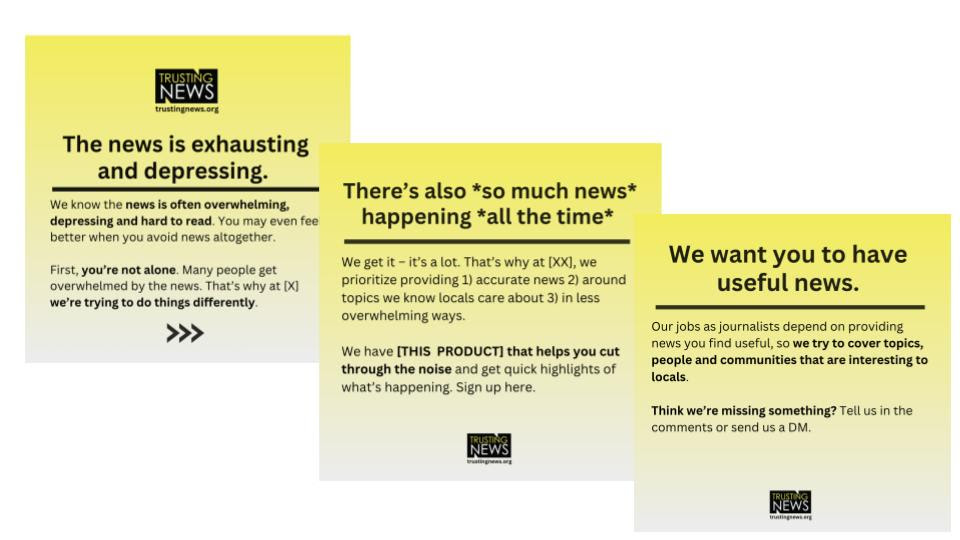
We also have a series of Canva cards you can copy and share, which were developed during a newsroom cohort we ran in 2024 to help newsrooms address news avoidance. Feel free to edit the text and rebrand these for your organization.
More about Local News Day
We’re proudly partners of Local News Day. If you missed it, we recently did a training as part of Local News Day on how to explain the value of local journalism in your daily coverage. (If you missed it, you can browse through the slides here!)
Learn more about Local News Day and get plugged in here.
At Trusting News, we learn how people decide what news to trust and turn that knowledge into actionable strategies for journalists. We train and empower journalists to take responsibility for demonstrating credibility and actively earning trust through transparency and engagement. Learn more about our work, vision and team. Subscribe to our Trust Tips newsletter. Follow us on BlueSky and LinkedIn.

Project manager Mollie Muchna (she/her) has spent the last 10 years working in audience and engagement journalism in local newsrooms across the Southwest. She lives in Tucson, Arizona, where she is also an adjunct professor at the University of Arizona’s School of Journalism. She can be reached at mollie@trustingnews.org and on Twitter @molliemuchna.