Discover six evidence-based ways to improve subscription, membership, and donation appeals, plus three pitfalls to avoid.
Asking audiences for money? Here is how to make a stronger case
By Volha Kananovich
Associate professor, Appalachian State University
Local newsrooms ask people for money all the time: Subscribe now. Support our work. Donate today. Get unlimited access.
But many of those appeals do not do a particularly good job making the ask.
That’s the takeaway from my recent analysis of some 1,300 subscription and donation appeals from local newspapers across the U.S. The study found that these appeals often underemphasize what research shows audiences value: trustworthy, useful, locally relevant reporting that helps them stay informed and feel connected to their communities.
For Trusting News readers, the practical takeaway is not that newsrooms need to become more aggressive salespeople. It’s that they need to make a clearer, more specific and more honest case for support.
Here’s what to try in your next subscription pitch, donation appeal or paywall message.
1. Tell people what their support makes possible
We know from research that audiences are more willing to support local journalism when they value the coverage: when it helps them stay informed about local news, follow specific issues they care about, keep up with developments that affect their lives and come from a source they trust. The appeal should make those benefits easy to see.
So, instead of leading only with “Subscribe to continue reading,” explain the work their money supports.
Try language like:
Your subscription helps keep reporters in the room — at public meetings, community events, court hearings and other places where decisions affecting your life are made.
Or:
When you subscribe, you help make it possible for our newsroom to cover schools, local government, public safety, weather emergencies and issues shaping life here.
2. Be direct about the financial reality
Most people do not know how fragile local news has become. Pew Research Center found in 2024 that most Americans believe their local news outlets were doing very or somewhat well financially, while fewer than one of five say they themselves pay for local news.
That gap matters. If people think the local newspaper is financially fine, they might not understand why their support is needed.
The reverse is also true: When people understand that local reporting needs financial support to continue, they might be more willing to help. Research has found that people are more likely to subscribe or donate when they see a local outlet as financially vulnerable, have experienced a local news source closing, or believe that news outlets cannot cover their costs (see page 24) without audience support.
So, say the quiet part plainly.
Try:
Advertising no longer pays for local reporting the way it once did. Reader support now helps determine how much reporting we can do.
Or:
Local reporting is expensive, and the business model that once supported it has changed. Your subscription helps keep reporters in this community.
Or draw on sample language from Trusting News’ roundup of ways to talk about newsroom funding.
3. Connect the appeal to community identity
Remind audiences that supporting local news is one way of investing in the place they live.
That matters because research has found that people who feel connected to their community are more inclined to support local news with their attention or money. When people explain why they pay for local news or might consider paying, they point specifically to its role in strengthening a sense of belonging to the place they live. Perceived community attachment can predict both whether people pay for local news and how much they pay.
That gives newsrooms a practical opening: Don’t frame the ask only as a transaction for access. Help people see support for local news as a way to stay connected to their community.
Try:
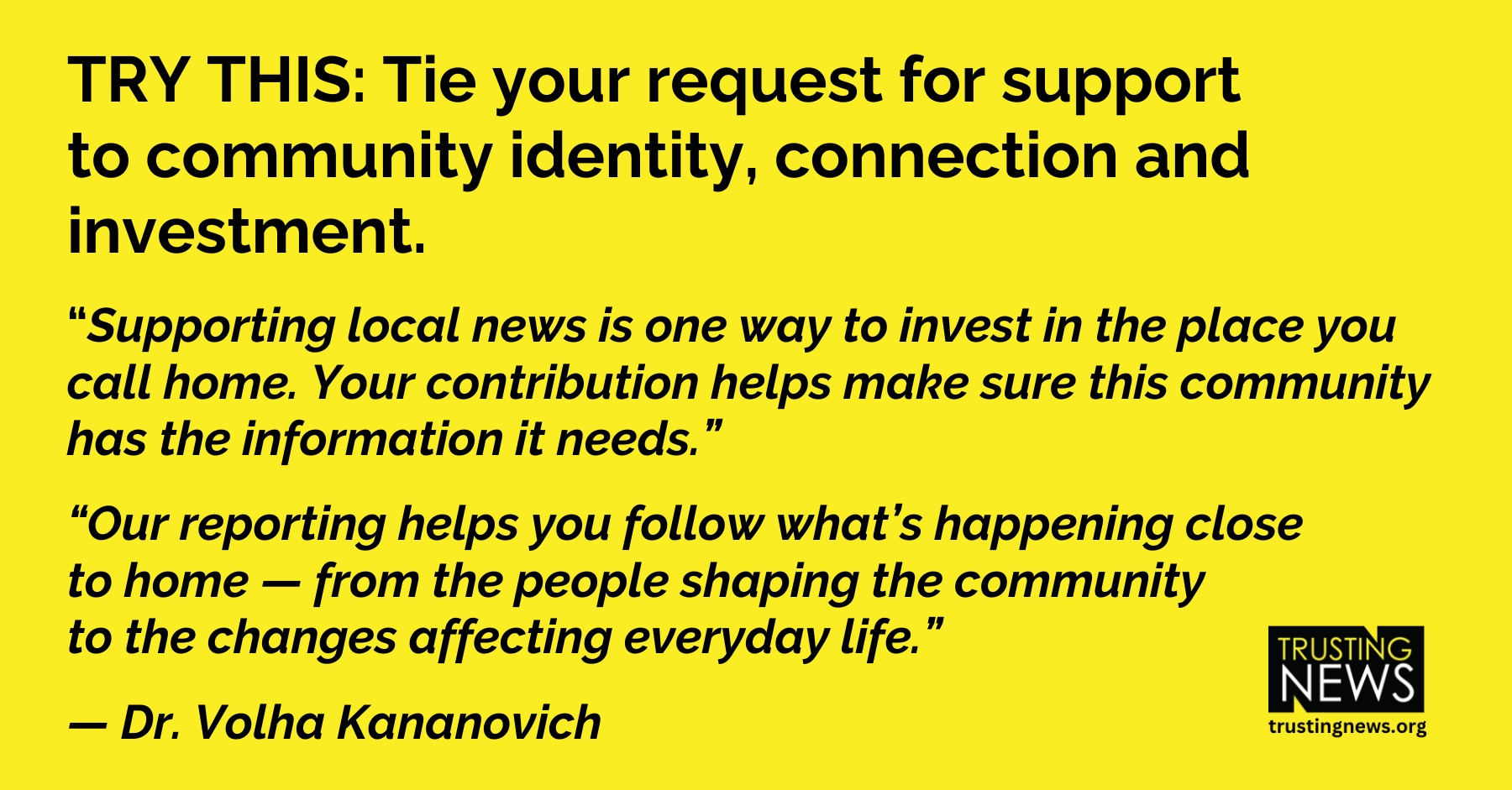
Supporting local news is one way to invest in the place you call home. Your contribution helps make sure this community has the information it needs.
Or:
Our reporting helps you follow what’s happening close to home — from the people shaping the community to the changes affecting everyday life.
4. Remind people you’re part of their community, too.
Research has shown that people may be more willing to financially support local outlets when they perceive journalists as part of their community — people who understand local realities and are personally invested in the place they cover.
So, don’t sound like a distant institution asking for money. Show that the support helps sustain reporting by people who are rooted in the same community.
Try:
We live here, too. Your support helps us keep showing up for the meetings, moments and stories that shape this place.
Or:
Your support helps keep reporting rooted here, with journalists who know this community and care about getting it right.
This kind of language draws on the persuasion principle of liking: People are more likely to respond to messengers they see as connected to them, familiar to them and invested in shared concerns.
5. Use reciprocity: “We’ve shown up for you. Will you show up for us?”
The idea behind the psychological principle of reciprocity is straightforward: People are more likely to respond to an ask when they can see what they’ve already received in return.
In local news appeals, that does not mean “you owe us.” It means reminding audiences of the public service they have already benefited from.
Try:
We made our storm coverage free because everyone needed access to reliable information. If that coverage helped you or someone you care about, please consider supporting the reporting that made it possible.
Or:
If you turn to us for verified local updates during emergencies, consider supporting us financially so the reporting is here the next time you need it.
This approach works best when people can clearly see what they have received. Tie the appeal to coverage people recognize and view as immediately actionable: storm updates, election guides, school-board coverage, restaurant inspections or public safety reporting.
6. Show images of journalists doing the work
Visuals matter. In one study involving a dozen experiments across three newsrooms, subscription appeals worked better when they showed journalists at work or photos from natural disasters the newsroom had covered rather than simply displaying the news organization’s logo.
So, try including visuals that show the work, such as:
- A reporter at a public meeting
- A journalist interviewing a resident
- A photo from a major local story your newsroom covered
- A behind-the-scenes image showing the reporting process
The point is to make the labor visible and help people see what their support pays for.
What you should be cautious about:
1. Avoid making sweeping quality claims
Studies suggest that perceived quality matters: People are more willing to pay for news they perceive as high quality (see page 9). But “perceived” is the key word. If readers do not experience the coverage that way, simply calling it “quality journalism” may fall flat, and research shows that a perceived lack of quality can dissuade people from paying for news.
This brings us back to the larger point: Get specific. A stronger appeal names the practices behind the quality: verification, public records work, follow-up reporting and explanations of how decisions affect people’s lives.
2. Be careful with social proof in donation appeals
Social proof is the idea that people look to others’ behavior as a cue for what they should do. In subscription appeals, it might help to say that many neighbors already subscribe or that readers consistently value the publication.
But donation appeals may be different.
Research suggests that when people think others are already donating, they may feel less responsibility to chip in themselves. That concern fits with the bystander effect: The more people seem to be sharing responsibility, the less any one person may feel personally called to act.
Your better bet here would be to shift from “lots of people are already helping” to “this only works when many people take part.” That preserves the sense of community support without making the problem sound already solved.
3. Be careful not to pile on too many reasons to give
Don’t make your donation appeal feel over-argued. Research suggests that if people feel a message is trying too hard to persuade them, they can become more skeptical or resistant. And adding more reasons does not always make the case stronger: Weak or generic reasons can dilute the stronger ones and make the overall ask feel less convincing.
A better approach is to lead with the clearest, most audience-centered reasons for support.
Not sure what will land? Use A/B testing to compare messages against one another. For a practical example, see how Trusting News partnered with PolitiFact on a newsletter A/B test that helped identify which strategy got more people to click the donate button and increased Net Promoter Score ratings.
Resources
For more examples and practical guidance, here are some related resources from the Trusting News team:
- A Trust Kit on explaining your funding and ownership demonstrates why it’s so important to talk about our business models and specific language to adopt.
- A test of newsletter campaign messaging with five newsrooms and the News Revenue Hub produced useful templates and mixed results.
- These principles can help your newsroom move beyond generic “support journalism” language and make a clearer case for the value of your work.
Volha Kananovich is an award-winning journalism educator and scholar. She is an associate professor of digital journalism at Appalachian State University, where she teaches journalism, data reporting and multimedia storytelling. Her research examines digital media, online engagement and the role of journalism in public life. You can learn more about her work at www.volhakananovich.com.
At Trusting News, we learn how people decide what news to trust and turn that knowledge into actionable strategies for journalists. We train and empower journalists to take responsibility for demonstrating credibility and actively earning trust through transparency and engagement. Learn more about our work, vision and team. Subscribe to our Trust Tips newsletter. Follow us on Twitter, BlueSky and LinkedIn.
