Could sharing AI literacy content serve as a form of public service journalism? Could it help audiences feel more informed? And most importantly, could it help strengthen trust in news organizations?
Use these templates to create and share AI literacy content
Want to get this Trust Tips newsletter in your inbox each Tuesday? Subscribe here.
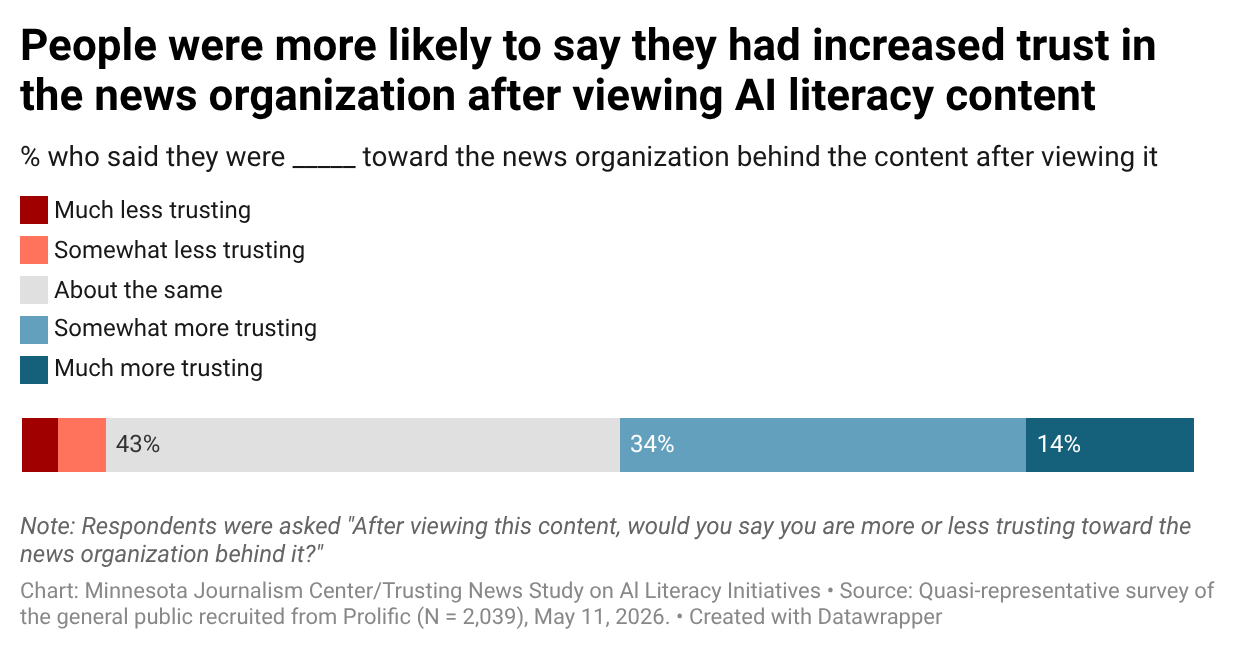
Our latest research suggests AI literacy might be a missing piece alongside transparency efforts when it comes to not losing trust while using AI in your journalism. Audiences responded positively when journalists helped them better understand this emerging technology, and news organizations appeared able to strengthen relationships by serving as guides and educators — not just people using the tools.
We walked you through the highlights of that research in last week’s Trust Tips. Today, we’ll help you act on it.
What our cohort newsrooms shared
Instead of asking only how newsrooms should disclose their own AI use, we wanted to understand what happens when journalists help the public better understand AI itself. Could sharing AI literacy content serve as a form of public service journalism? Could it help audiences feel more informed? And most importantly, could it help strengthen trust in news organizations?
To explore those questions, our AI literacy newsroom cohort brought together news organizations to create, customize and share AI literacy content with their audiences.
This content was not primarily focused on how a newsroom uses AI. Instead, it focused on helping the public understand AI itself: how AI works, what AI can and cannot do, practical implications of AI, questions people are asking, and information focused on “how to use this” and “how to protect yourself.”
The content focused on three main topics:
- How AI works
- Consumer concerns
- Mis/disinformation
The newsrooms shared the content primarily on social media platforms including Instagram, TikTok, WhatsApp, Nextdoor, LinkedIn and Facebook. Some newsrooms shared the content on their own websites, and some created additional content in the form of FAQ’s and in-depth video interviews. In addition, Trusting News created an AI literacy quiz for newsrooms to share.
In terms of format, most newsrooms shared social cards. Some created videos.
To make sharing AI literacy content as easy as possible for newsrooms, Trusting News researched and wrote the language for the content and added it to customizable social card templates using Canva. Read more about what each contains and click on the links below to make a copy of these social assets in your own Canva account. Once you make a copy you can personalize them and adjust them for your organization’s needs (branding, content changes, etc.).
Copy these social cards
What can AI do and what can’t it do?
These social cards explain the limitations of AI and where the technology excels
What AI can do and what it can’t
What AI can do and what it can’t (No graphics)
Lo que la IA puede (y no puede hacer)
Is AI bad for the environment?
These social cards explain AI’s impact on the environment and how people can limit its negative effects
Is AI bad for the environment?
Protecting your privacy in the age of AI
These social cards provide tips on how to protect your privacy in the age of AI
Protecting your privacy in the age of AI
Protegiendo tu privacidad en la era de la IA
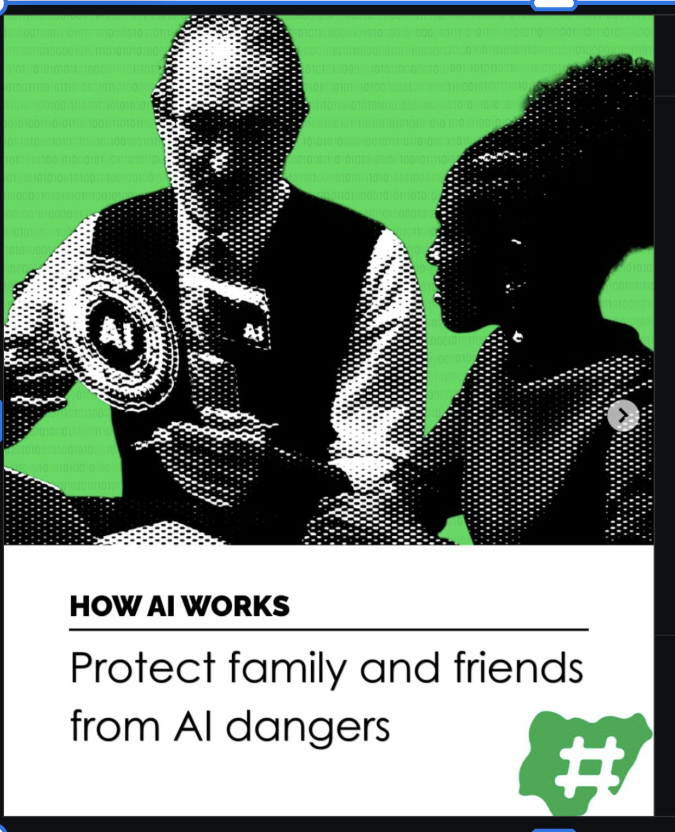
Protect family and friends from AI dangers
These social cards provide tips for protecting family and friends from AI scams
Protect family and friends from AI dangers
Protege a tu familia y amigos de los peligros de la IA
The full list of available social cards for you to share is our AI Literacy Trust Kit. Most cards are available to share in both English and Spanish.
Copy these video scripts
We also created Trusting News AI literacy: Draft scripts for social videos to make it easier for you to create social videos that will help your audience better understand AI.
KXAN used the scripts to create a reel on Facebook. offering tips on how to spot AI-generated images and videos. Using a conversational creator-style format, a journalist spoke directly to the camera with minimal editing and on-screen text throughout the video.
The Detroit Free Press used the scripts to create a video on Instagram. explaining what generative AI is, how it works and its limitations. The video combined narration, futuristic b-roll and on-screen text, and was shared across Instagram, TikTok, Facebook and YouTube. The newsroom also repurposed the information into Instagram social cards.
Copy this AI quiz
One way newsrooms can engage with their audience about how AI works is through a quiz. When shared by our cohort newsrooms, the quiz received almost 10,000 views and more than 2,800 completions. You can watch this video to see what the quiz experience was like.
The quiz contained a total of 14 true or false questions. When the user answered each question they had an option to view more information about their correct or incorrect answer. In both cases, the user learned a little bit more context about why their answer was incorrect/correct. In some cases, there are links provided where the user can get even more information.
Since the newsroom received positive feedback after sharing the quiz, Trusting News is making the questions and answers we used available to you to help you build a quiz to share with your audience: Trusting News AI Literacy Resource: AI Quiz questions. Find a version of these questions in Spanish here. The questions were adapted from questions other researchers have used to measure an individual’s AI literacy knowledge. The answers were written by Trusting News.
Other tools to help you create AI literacy content
We have a new AI Literacy Trust Kit to help you share AI literacy content. In the kit you will find all of the resources mentioned above and:
- A survey to ask your audience what they want to know, what they are worried about, what formats information is the most helpful, etc.
- Sample agendas for hosting an AI literacy event. Newsrooms found that hosting events focused on how AI works and how newsrooms use AI can build trust with their audience.
At Trusting News, we learn how people decide what news to trust and turn that knowledge into actionable strategies for journalists. We train and empower journalists to take responsibility for demonstrating credibility and actively earning trust through transparency and engagement. Learn more about our work, vision and team. Subscribe to our Trust Tips newsletter. Follow us on Twitter, BlueSky and LinkedIn.

Assistant director Lynn Walsh (she/her) is an Emmy award-winning journalist who has worked in investigative journalism at the national level and locally in California, Ohio, Texas and Florida. She is the former Ethics Chair for the Society of Professional Journalists and a past national president for the organization. Based in San Diego, Lynn is also an adjunct professor and freelance journalist. She can be reached at lynn@TrustingNews.org and on Twitter @lwalsh.