What viewpoints would help your team see the world with more complexity? We have suggestions for how to get to know potential colleagues.
Diversify your staff by adding these Q’s to job applications and interviews
Want to get this Trust Tips newsletter in your inbox each Tuesday? Subscribe here.
When we worked with partner journalists to create our Dimensions of Difference Hiring Guide in 2022, we wanted to encourage newsroom leadership to learn about how job applicants would show up for work.
How would their values and views influence their approach to their own journalism — and influence the ways they contribute to the team’s coverage overall? What experiences do they have? What do they naturally understand and empathize with? What do they observe about who is well served by journalism — and who isn’t?
Too often, newsrooms fail to assess and account for the gaps in their staff’s values and views. That leads to a lack of awareness of what’s missing in their coverage.
Trust Tips regulars will not be surprised to know that when it comes to the homogenous nature of newsrooms, one area in which I am especially eager for more intellectual diversity is political leanings. I get less pushback than I used to on the basic premise that newsrooms tend to skew liberal. And depending on who you serve and the topics you cover, that is likely to influence both who your content feels relevant and useful to (your public service mission) and how far your content reaches (your financial sustainability).
I don’t think newsrooms are going to start asking job applicants about how they vote, nor do I think that would be especially helpful. But I DO think the application and interview process could invite people to share the lens through which they see the world, if they feel comfortable doing so.
Let me tell you what we recommend, then I’ll show you how it is incorporated into processes like The 19th’s.
Our practices and suggestions
When we last hired at Trusting News, our application included an optional question outlining why “diversity in lived experiences, perspectives, knowledge, and ideas” is important to our team. We invited applicants to include anything they chose to share about their background and identity.
Then in the interview process, we built off of that with other questions from our Hiring Guide that are designed to invite people to share how they see the world, and how they engage with people or ideas they’re not very familiar with. Questions like:
- What voices or perspectives do you feel are not represented well enough in the local media? Feel free to consider any type of demographics, life stages, interests, etc. What stories are we missing?
- It’s so important that journalists work to understand a vast array of perspectives. What views, values or experiences do you understand well, and which are you most curious about or do you wish you understood more deeply?
- We know that newsrooms tend to be made up of people who come from similar backgrounds and have similar experiences. We believe we have a responsibility to be more representative of society. Do you have any thoughts to share, either about what you could bring that might help us diversify or about how newsrooms in general can do a better job representing their communities?
- We encourage people to bring their whole selves to work. Do you want to tell us about any parts of your life, your experiences, or your identity that inform how you approach your work? Feel free to consider issues of identity or disability, military service, cultural factors, previous careers, socioeconomic factors, subjects studied, etc. (Answering no is absolutely fine.)
How to add these to your hiring process
The first step is to identify what is important to you. This might involve general goals around representation, or might involve assessing where you have gaps on your team and what perspectives or experiences you’d love to add to your staff.
Some questions to consider include: What voices do you wish were at the table when you’re discussing how to cover specific topics, or how to be reflective of and useful to specific communities? Do you want to consider candidates’ experience with rural life? With the immigration system? With navigating disabilities?
The questions listed above can invite people to share any of those things. And adding questions to your interview process is fairly straightforward, as long as all candidates are given the same invitations and you’re clear as a team about how their answers will be considered or evaluated.
I’m always on the lookout for news outlets that seem especially curious about who job candidates are as human beings. I was happy to see two sections in a recent job application from The 19th.
What The 19th asks candidates, and how they use the answers
First, the language up top about diversity is stellar. It tells a story of the organization, going way beyond the typical note that people of all backgrounds are encouraged to apply.
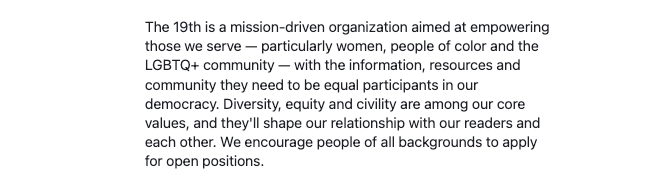
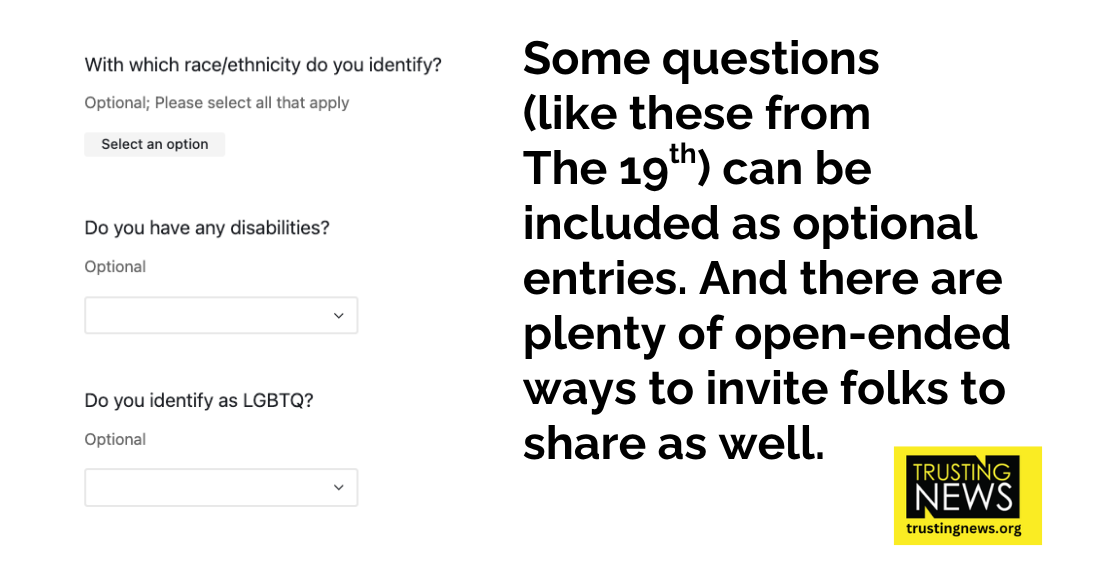
Then the application itself includes optional fields inviting information about candidates’ identities.
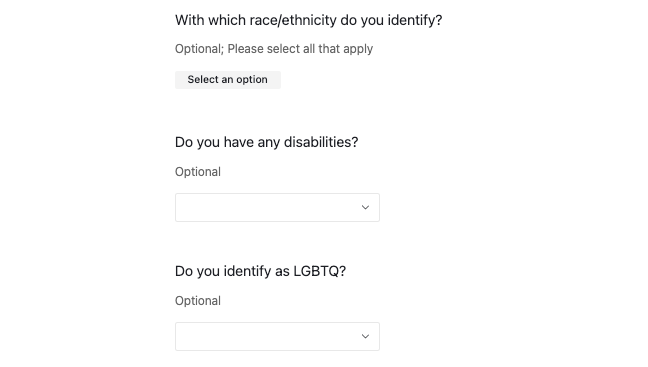
Zurii Conroy is the People Operations Manager at the 19th. She said those fields are standard for them, and her department collects data to facilitate an equitable, inclusive hiring process. It’s used to ensure a diverse pool of candidates throughout the process. The data is visible in aggregate to the people doing the hiring, but it’s not attached to specific applicants.
Whether that information is part of hiring editors’ decisions or not, it’s important to be clear with candidates about how it’s used. The 19th has this at the top of its application: “Required fields are marked with an asterisk; please note that demographic information is marked as optional, but is collected to help us evaluate our recruiting efforts.”
If editors at The 19th wanted to understand people’s values, experiences and views, Zurii said, they could add questions to the interviews. I asked about what types of experiences might be most helpful to them. She said that because of the goals and values of their news outlet, they tend to get applicants who can picture themselves in their newsroom. Factors around things like gender and sexuality are likely to arise when candidates are asked why they want to work there. Their team is remote, and questions around geography and experience with different communities or parts of the country are also likely to come up.
How do you hire?
I’d love to see examples of job applications, interview questions or candidate assessment practices that touch on the things we’re talking about here. I’d also welcome input about how newsrooms could diversify the value and views represented on their teams. Please email any observations or suggestions to joy@TrustingNews.org.
Note: At Trusting News, we take your privacy seriously. Journalists trust us with a lot of sensitive information — from audience analytics to newsroom culture tensions — and we never share those publicly unless we’re sure we have permission to do so. If you email us, you can trust that we’ll learn from what you send but won’t share it more broadly without checking with you.
At Trusting News, we learn how people decide what news to trust and turn that knowledge into actionable strategies for journalists. We train and empower journalists to take responsibility for demonstrating credibility and actively earning trust through transparency and engagement. Learn more about our work, vision and team. Subscribe to our Trust Tips newsletter. Follow us on Twitter, BlueSky and LinkedIn.
Executive Director Joy Mayer (she/her) founded Trusting News in 2016 after a 20-year career in newsrooms and teaching. She lives in Sarasota, Florida, and can be reached at joy@TrustingNews.org.