Even audiences with low trust in news reported increased willingness to return to the news organization for information and higher trust after viewing a single example of AI literacy content.
AI literacy content builds trust and engagement across audiences
People have mixed feelings about artificial intelligence. Many people are skeptical, worried or distrustful of AI, and journalists are increasingly navigating how to use these technologies without damaging audience trust.
Since 2024, Trusting News has been focused on helping newsrooms answer a central question: How can journalists use AI while maintaining or even building trust with their audiences?
Our previous research found that audiences overwhelmingly want transparency around AI use in journalism. In one Trusting News survey, 94% of respondents said journalists should disclose when AI is used in the reporting process. But as our work evolved, we began to see that transparency alone was not enough.
Audiences still have questions. Many people do not understand how AI works or how it shows up in their daily lives. Our research also showed more than 80% of people said they would welcome AI literacy content from journalists. That led to a new phase of our work: AI literacy.
Instead of asking only how newsrooms should disclose their own AI use, we wanted to understand what happens when journalists work to help the public better understand AI itself. Could sharing AI literacy content serve as a form of public service journalism? Could it help audiences feel more informed? And most importantly, could it help strengthen trust in news organizations?
To explore those questions, Trusting News launched an AI literacy newsroom cohort that brought together news organizations to create, customize and share AI literacy content with their audiences. This work was supported by a grant from the Patrick J. McGovern Foundation
This project focused on answering two central questions:
- Did people learn something from AI literacy content shared by journalists?
- Did that content improve trust in news organizations?
What we learned
- Most people who saw the AI literacy content said the content was useful and relevant to their daily life.
- Most people were interested in seeing more AI literacy content like it.
- Close to half (48%) said they had more trust in the news organization after viewing just one single sample of AI literacy content (which has us imagining what might be possible if they saw similar content regularly!).
- Close to half (47%) of respondents said they were “more likely to turn to this organization” for future information on AI.
- Among respondents with little or no trust in news, close to one-third said they would return to the news organization for information (AI-related topics and general news), and 35% reported that engaging with the one piece of content increased their trust in the organization.
- People continue to expect journalists to have guardrails (AI use policies) around their use of AI. Across both surveys, respondents signaled that transparency and ethical standards matter. Audiences might appreciate AI literacy efforts, but they also expect newsrooms to communicate what guardrails they have in place guiding their use of AI.
AI literacy is not about convincing audiences to embrace AI or defending every newsroom decision involving these tools. It is not an attempt to persuade skeptical audiences that AI is inherently good.
Instead, AI literacy can function as a public service. Audiences are actively looking for trustworthy information to help them understand how AI works, how it may affect their lives and how to navigate both the opportunities and risks involved. The findings from this research suggest journalists can play an important explanatory role in that process. In addition, helping people navigate the evolving information landscape is good for journalists, who certainly don’t benefit if people have even more trouble than they used to determining what information to trust.
How journalists can act on these insights
We’re excited about what we learned and have suggestions for how journalists can act on these insights in our new AI LIteracy Trust Kit. Our focus is always on creating actionable insights, so head there if you’re ready to incorporate new ideas into your journalism. It includes:
- Templates of AI literacy content for you to copy and share including social video scripts, customizable social cards and questions for an AI literacy quiz
- Examples from newsrooms who shared this content. See what this content looks like when shared on different social platforms and news organization websites.
- A survey so you can ask your audience about their AI literacy needs. Find out what they are most curious about, what they want help with and what formats best suit their needs.
- Guidance on how to host AI literacy events. Learn best practices for hosting, see examples of how other newsrooms did this and view sample event agendas to help you duplicate this work in your community.
- Surveys to help you measure the impact of this work
Diving into the research
For those of you interested in more details about the research, the rest of this post will outline:
- How we did this work. Learn more details about who was surveyed and who responded.
- Usefulness and relevance of content. Dive deeper into what news consumers thought about the usefulness of the AI literacy content, including their desire for more and relevance to daily life.
- How the content built trust. Learn more about what people said they thought about the partner newsrooms after viewing the content, specifically how it affected their trust and likelihood to turn to the organization again for information.
- How personal feelings about news and AI impacted results. Learn how people with high and low trust in news responded to the AI literacy content and if someone’s use or lack of use of AI had an impact.
- Trends in public perception of AI. See how the public’s opinion about AI in news has changed over our years of research.
- How journalists can act on this research. Learn what you should do to build trust with your community related to AI, including tools to help you do the work.
How we did this
Trusting News created AI literacy content designed to help the public better understand artificial intelligence in practical, accessible ways. The content included social cards, social videos and AI literacy explainers.
This content was not primarily focused on how a newsroom uses AI. Instead, it focused on helping the public understand AI itself: how AI works, what AI can and cannot do, practical implications of AI, questions people are asking, and information focused on “how to use this” and “how to protect yourself.”
Two survey groups
Trusting News worked with Dr. Benjamin Toff, director of the Minnesota Journalism Center at the University of Minnesota, to conduct this research. We gathered data through two survey collection methods.
- Surveys tied directly to newsroom audiences. Trusting News worked with 10 participating newsrooms that customized and shared AI literacy content with their audiences. Two of the participating newsrooms served Spanish-language audiences and two were outside of the United States, located in Canada and Nigeria. Newsrooms customized the content in different ways. Some changed brand colors and formatting to better match their organization, while others used only certain pieces of the content or created additional materials to supplement and localize the information for their communities. Before creating and sharing any content, participating newsrooms also surveyed their audiences to better understand their AI literacy needs, including what people wanted to know about AI, what concerns they had about AI and what content formats they found most useful. That audience-first approach helped shape the materials that were ultimately shared. You can do this too using the survey resources in our new AI Literacy Trust Kit.
- Quasi-representative U.S. sample. Trusting News also surveyed a broader and more representative U.S. audience through the research and survey tool Prolific. Respondents in this group were randomly shown one of three examples of AI literacy content that had previously been shared by participating newsrooms. Using a more representative sample allowed us to test reactions outside of existing newsroom audiences and better understand how the broader public might respond to AI literacy content from journalists.
We used these two approaches because having newsrooms ask their audience directly provides invaluable information to the newsroom about their individual news consumers and their feelings about the newsroom’s content and news approach. It also allows us to hear directly from real news consumers, who encounter the news content on their own, in their news environment. The broader, more representative sample then broadens the findings and helps test whether reactions hold across a wider range of people, including those without existing relationships with a newsroom.
An important note: Many of the findings across the two groups were similar, strengthening our confidence in the results. In total, we heard from 2,314 respondents (2,039 from the quasi-representative sample and 275 from newsroom cohort surveys). Overall, we did not observe meaningful differences in responses across key demographic groups. While some skews were expected in certain subgroups, particularly age within the newsroom cohort (more than half reported being 65 or older) and education levels within the representative sample (more than eight-in-ten respondents (85%) reported completing some form of higher education), these patterns did not appear to meaningfully affect our overall interpretation of results.
People found AI literacy content useful and relevant
Most people who saw the AI literacy content said the content was useful and relevant to their daily life and they were interested in seeing more AI literacy content like it.
Below is a closer look at how people responded.
Was the AI literacy content useful and relevant?
Generally speaking, how useful did you find the information you just saw?
- Very or somewhat useful: 77% (cohort audience), 93% (general public)
- Neither useful nor not useful: 5% (cohort audience), 3% (general public)
- Somewhat or not at all useful: 7% (cohort audience), 2% (general public)
How relevant is the information in this content to your daily life?
- Very or somewhat relevant: 73% (cohort audience), 83% (general public)
- Neither relevant nor irrelevant: 11% (cohort audience), 8% (general public)
- Somewhat irrelevant or not at all relevant: 5% (cohort audience), 8% (general public)
Would you be interested in seeing more AI literacy content like this?
- Yes, definitely: 60% (cohort audience), 56% (general public)
- Maybe: 21% (cohort audience), 33% (general public)
- No, not interested: 8% (cohort audience), 10% (general public)
Note: Some respondents in both surveys did NOT respond to these questions.
Almost 90% of the respondents in the general public survey said they were likely to use this information in their daily life, with 61% saying they were “extremely” or “very” likely to.
When that same group of people was asked if they were likely to share this content online, the group was split on if they were likely to. The slight majority (51%) said they were not likely, while 48% said they were likely.
Did the AI literacy content help you learn something?
When asked if the content helped them learn something new about AI, 70% of the cohort audiences who responded to the survey said they did learn either a lot or a little.
The general public surveyed through Prolific, on the other hand, was somewhat less likely to say they learned from the content. 59% of these respondents said, “most of the information was a review of things I already knew,” and 30% said, “most of the information was new, with some helpful review.”
One important factor when interpreting these results is the demographic makeup of the two groups. The newsroom cohort sample skewed older, and an equal number of news consumers who responded to the newsroom cohort surveys reported using AI weekly or more or having never used AI (28%). In the survey of the general public recruited through Prolific, 75% of respondents said they used AI weekly or more, with 41% reporting they use AI every day.
In both survey groups, the majority of respondents said they have “about the same number of questions” about AI after viewing the content: 59% of the general public and 50% who responded to the newsroom surveys.
This finding highlights both the complexity of AI issues and the reality that audiences still have many unanswered questions about the technology. AI is evolving quickly, and many people are still trying to understand how it affects their work, privacy, relationships, safety and access to information. The results also reinforce the need for continued AI literacy efforts from journalists.
Also, even though almost 60% of people from the representative sample said most of the information was a review of things they already knew, many still found the content useful and relevant, wanted to see more of it and said they would return to the newsroom for more information. That suggests audiences may value not only learning entirely new information, but also having trusted sources organize, verify and contextualize information they are already encountering elsewhere.
Did the AI literacy content build trust in the news organization?
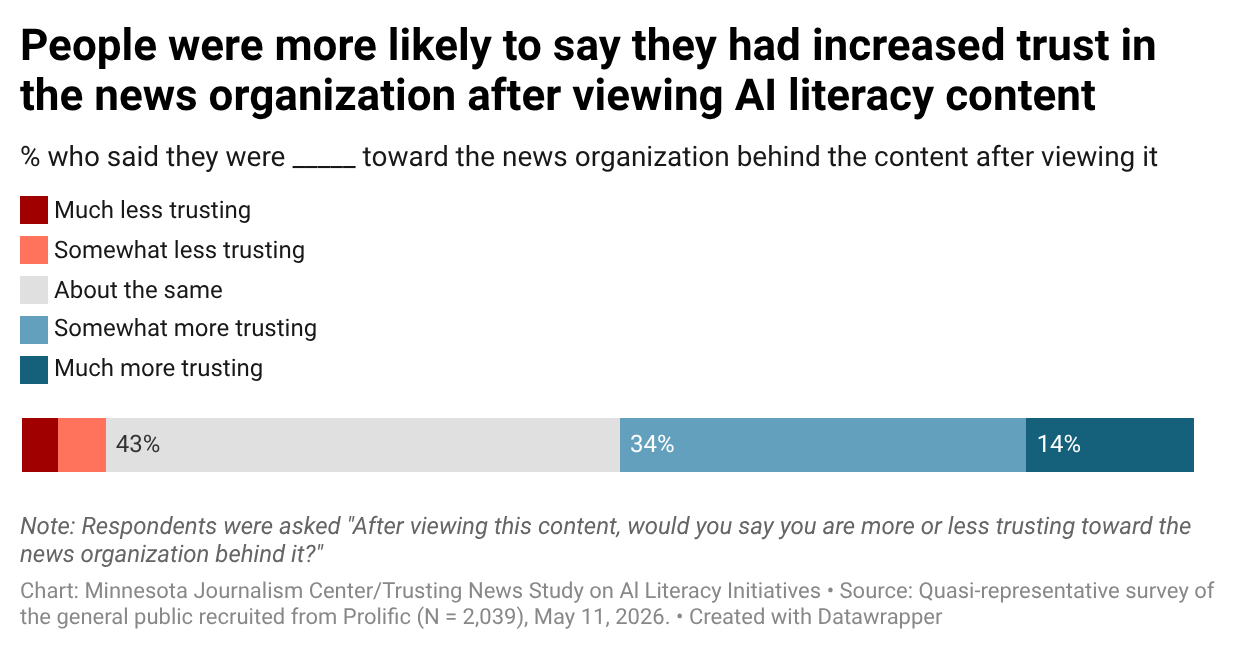
A slight majority of respondents in the survey of the general public sample said they were more trusting in the news organization after viewing one example of AI literacy content. Forty-eight percent said they were much more or somewhat more trusting and 43% said their trust was about the same. Only 7% said they were much less or somewhat less trusting after viewing the one piece of content.
This is especially notable because respondents viewed only one piece of content before answering these questions. Even a brief interaction with useful AI literacy content appeared capable of positively influencing trust perceptions for many people. It also raises important questions about what sustained or repeated exposure to this kind of journalism might do over time. For respondents whose trust stayed the same, would ongoing AI literacy efforts eventually strengthen trust further? Could consistency and repetition deepen audience trust?
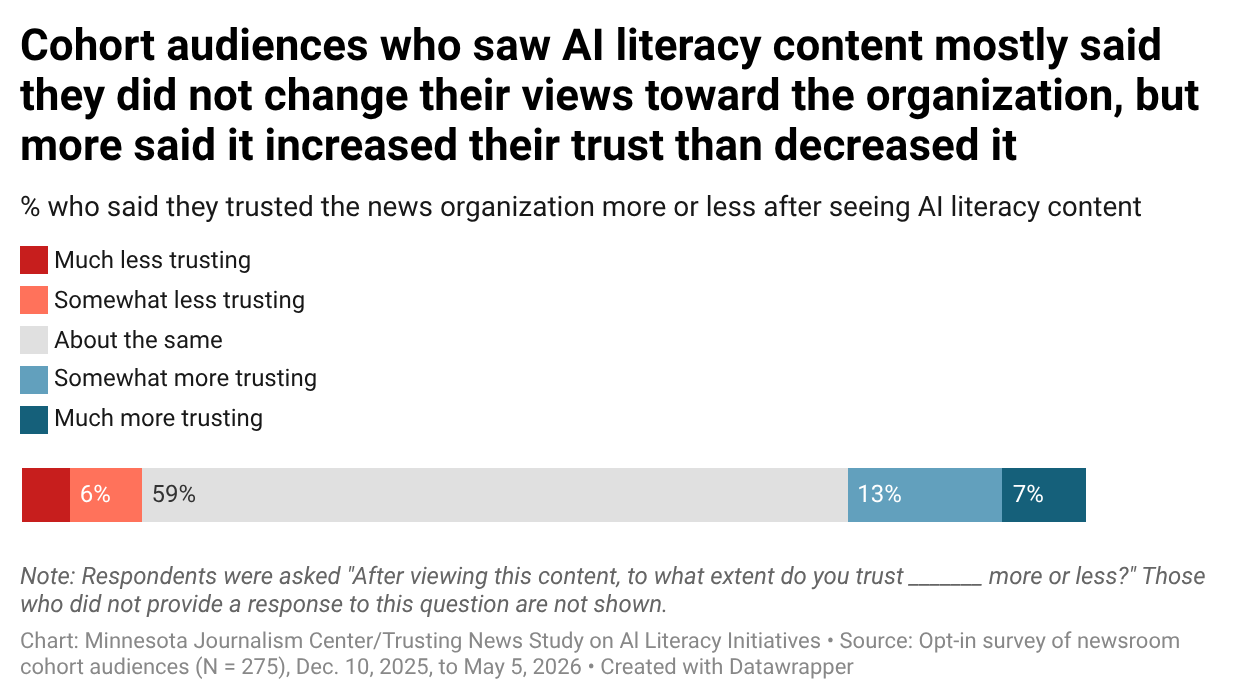
The news consumers who responded to the newsroom survey were less likely to say the content led them to trust in that specific newsroom more, but for a majority of them their level of trust in the news organization stayed the same.
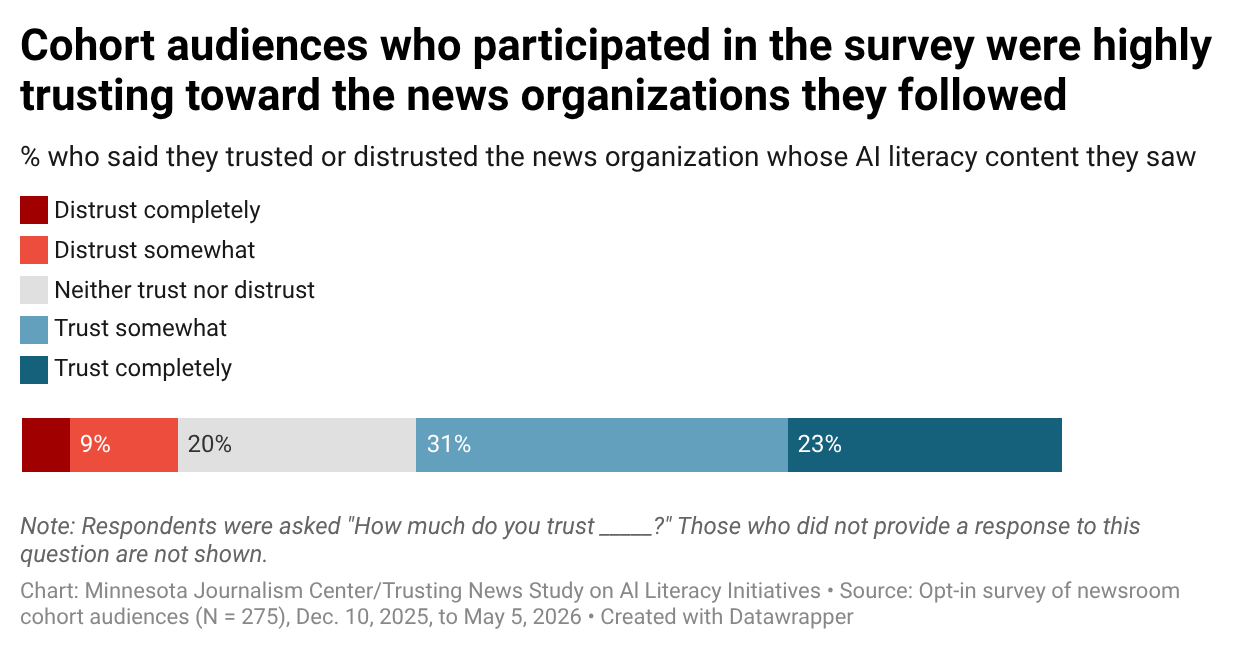
It is worth noting, however, that most of the news consumers responding to the newsroom surveys (54%) already said they had “somewhat” or “complete” trust in the newsroom to begin with. In other words, these tended to be audiences who already had an existing relationship with and a high level of baseline trust in the newsroom, which likely made it more difficult to produce further increases in trust. In that context, maintaining trust while discussing a topic that is rapidly changing and people have complex views about may itself be an important outcome. It also suggests AI literacy content did not damage trust among audiences who were already engaged with the newsroom and may even have reinforced those relationships.
Among respondents with little or no trust in news, about one-third said they would return to the news organization for information (AI-related topics or general news), and 35% reported that engaging with the one piece of AI literacy content increased their trust in the organization. This highlights a significant opportunity to rebuild trust with skeptical audiences. Read more about those findings further down in this post.
Did people want more information from news organizations after seeing AI literacy content?
To better understand reactions among the general public to AI literacy content, we specifically focused on whether respondents would return to the news organization again for information. Returning to a news source for information can reflect perceptions of reliability, usefulness, credibility and loyalty to a news brand.
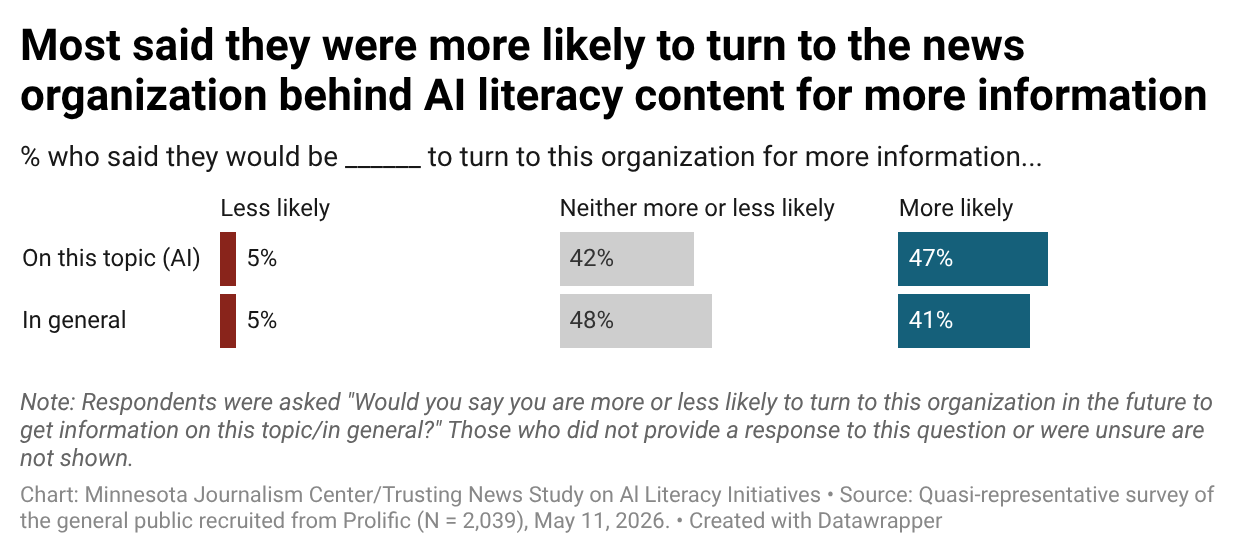
Close to half (47%) of respondents from the representative sample said they were “more likely to turn to this organization” for future information on AI. When asked if they would turn to this news organization in the future for information in general (not specific to AI), 48% said they were neither more or less likely.
In both cases, when looking at the likelihood of a respondent to return to the news organization for information about AI or information in general, only 5% said seeing the one piece of AI literacy content made them “less likely” to return to the news organization.
Again, these findings are notable considering respondents were reacting to only one piece of content. One brief interaction may not be enough to dramatically change long-term news consumption habits, but it may be enough to begin shaping perceptions of a newsroom as useful, relevant and trustworthy. Continued exposure to this kind of explanatory journalism could potentially have a stronger effect over time.
The type of AI literacy content also appeared to matter.
Respondents in the representative sample were randomly assigned one example of AI literacy content previously shared by the newsrooms participating in the cohort. The examples were social cards focused on the following topics:
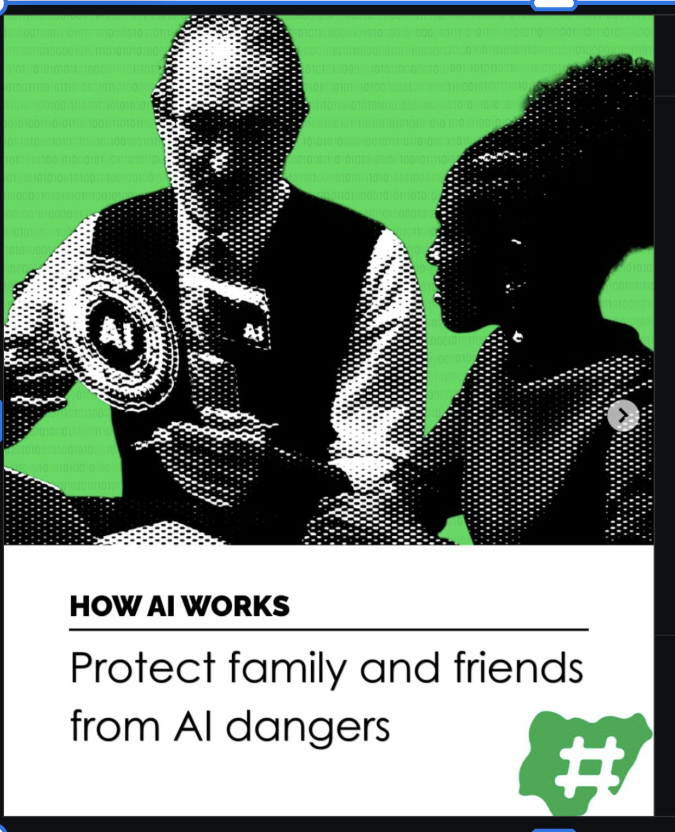
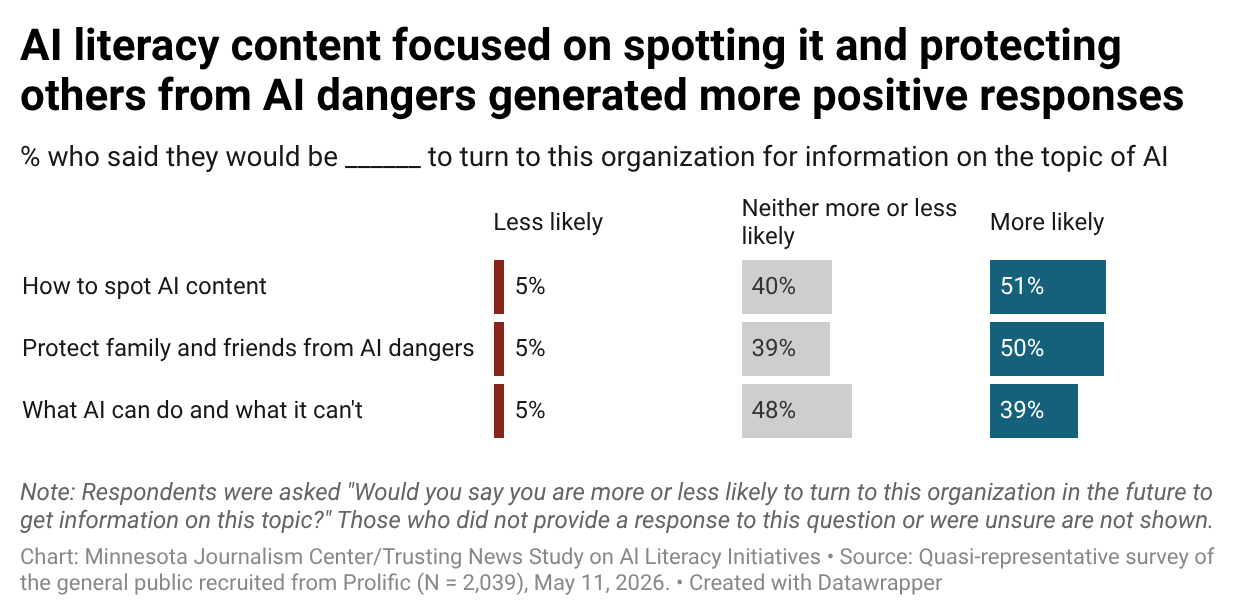
Respondents were slightly more likely to say they trust in the news organization and would turn to the news organization again for information after viewing the content focused on how to spot AI and how to protect family and friends from AI dangers.
For example, when asked, “would you say you are more or less trusting toward the news organization behind it?” 38% of respondents who viewed the “What AI can do and what it can’t” social card said they were more trusting, while 49% and 54% said they were more trusting for “How to spot AI content” and “Protect family and friends from AI dangers,” respectively.
When asked if they would turn to the news organization for “information in general” or “future information about this topic,” the “How to spot AI content” and “Protect family and friends from AI dangers” social cards performed about 10 percentage points better, meaning 10% more of the people who viewed those cards said they were likely to turn to the news organization for information on this topic.
AI use and trust in news
Does an individual’s general trust in news matter?
We found a similar trend when comparing perceptions of usefulness with trust in news. Across all groups, from people who said they completely trust the news to those who said they do not trust it at all, at least 90% rated the content as “somewhat” or “very” useful.
We also found that people who said they do not trust in news wanted more content like this. When asked “would you be interested in seeing more AI literacy content like this?” here is how different groups responded:
- Those who do not trust or have low trust in news: 52% yes, definitely, 33% maybe, 14% no, not interested
- Those who neither trust or distrust in news: 47% yes, definitely, 42% maybe, 11% no, not interested
- Those who trust in news: 64% yes, definitely, 30% maybe, 6% no, not interested
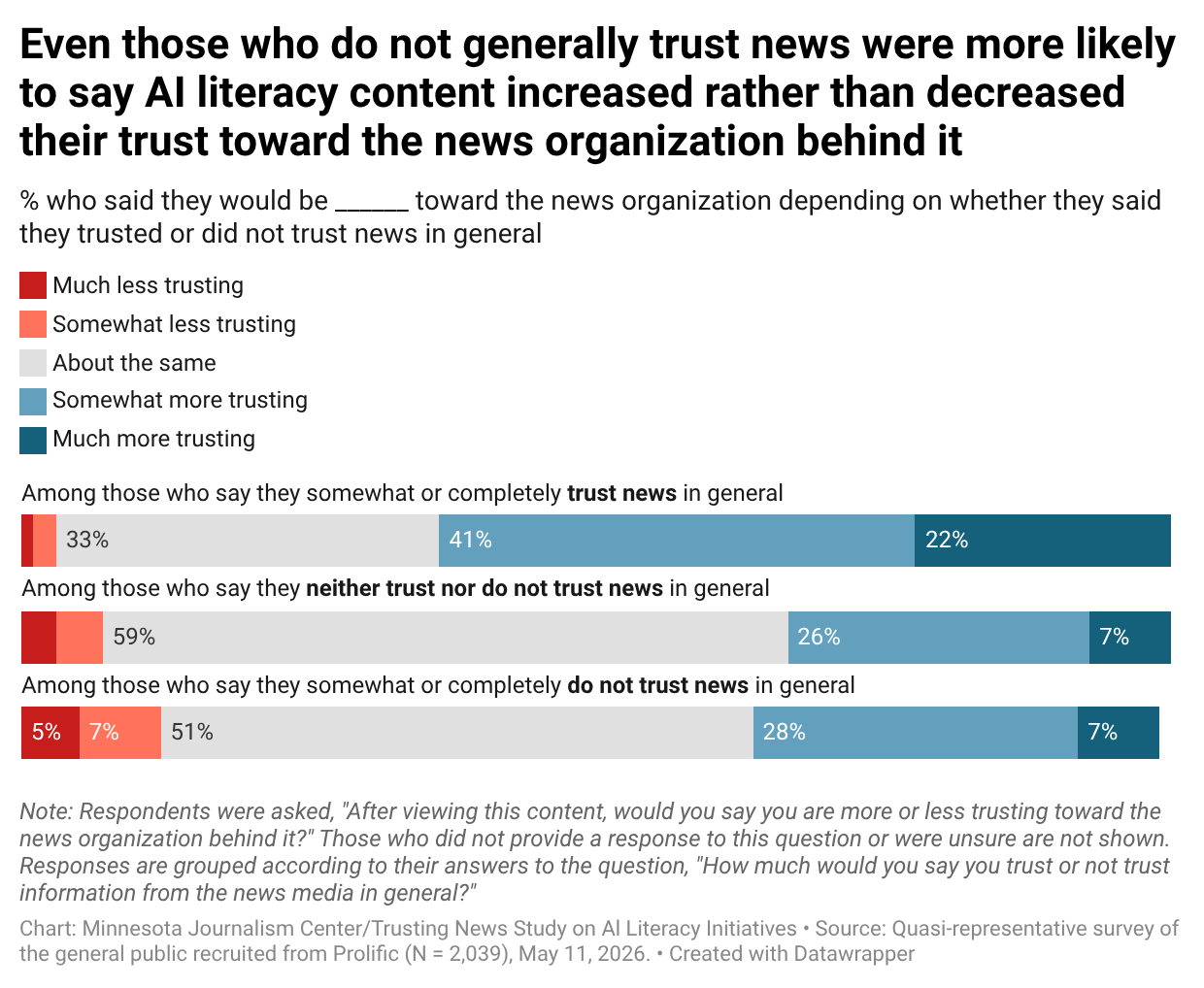
The research shows the AI literacy content made the most trust gains with people who are already trusting in news, but those who have low trust in news also reported gaining trust in the news organization after seeing the content.
The same is true for people’s likelihood to turn to the news organization again in the future for information. The data shows people who trust in news most are the most likely to turn to the news organization again for information in general or about AI, but those who trust in news less also reported they would turn to the news organization again.
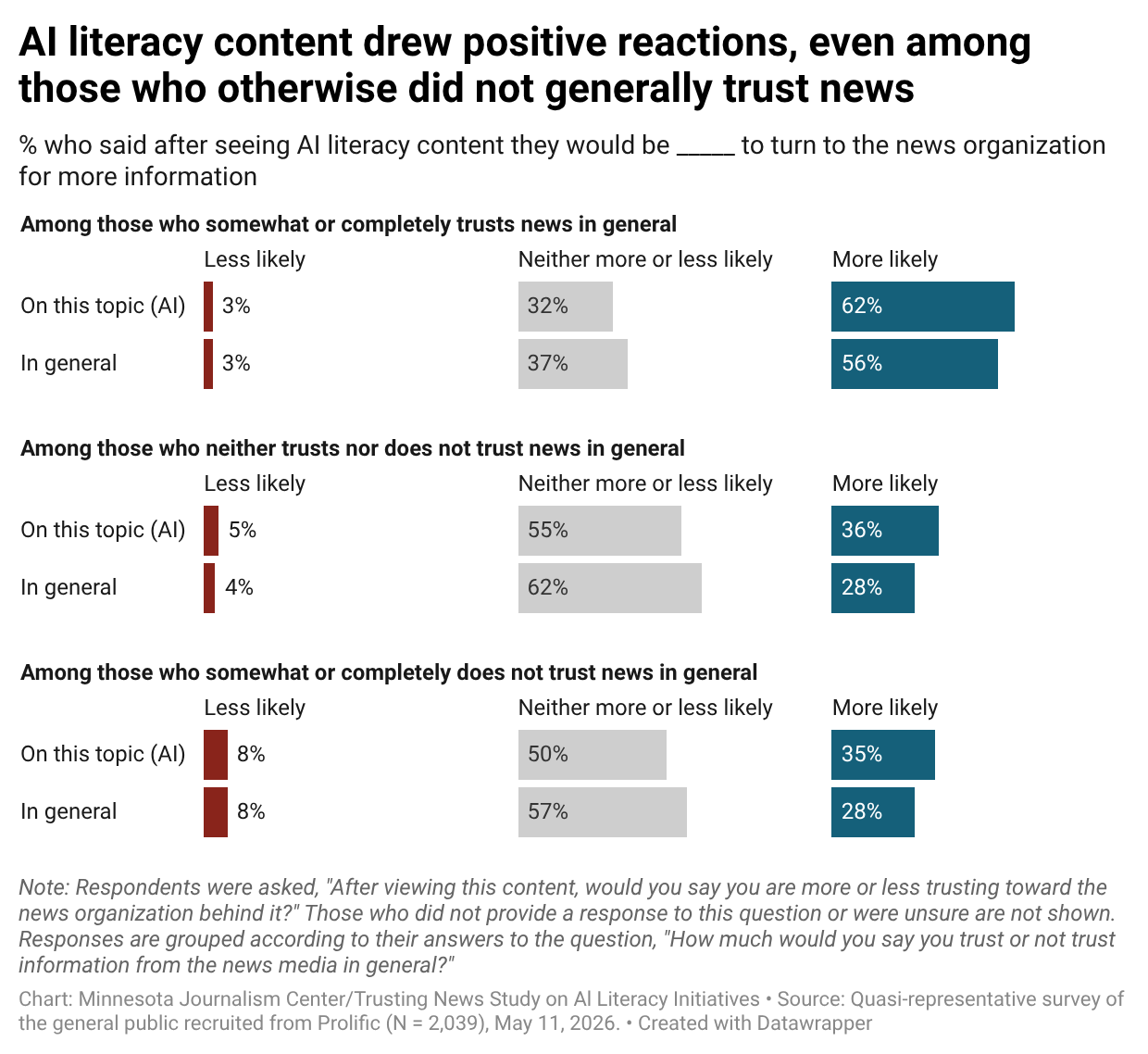
These findings suggest AI literacy content may have the potential to strengthen relationships with existing loyal audiences while also helping news organizations engage people who are typically more skeptical of news. Unsurprisingly, the strongest results came from respondents who already reported higher levels of trust in news, but the findings among lower-trust audiences are especially notable.
Even among people who said they have little or no trust in news, roughly a third said they would return to the news organization for information after viewing the content, whether for AI-related information or news more broadly. Many (35%) also reported increased trust in the news organization itself after viewing just one piece of AI literacy content.
Together, these findings point to a significant opportunity for news organizations to use clear, useful, audience-centered AI content not only to retain loyal audiences but also to build credibility and engagement with low trust community members.
Does personal AI use and current AI knowledge matter?
For the survey of the general public, respondents were asked a series of six questions about AI literacy, which involved identifying examples of AI across multiple domains including online shopping, health products, devices in the home, etc. (These questions were adapted from those previously asked by Pew Research Center in 2022). Depending on the number of answers they answered correctly, they were grouped into one of three groups:
- Low AI literacy knowledge: those with less than four correct answers
- Medium AI literacy knowledge: those with four or five correct answers
- High AI literacy knowledge: those who provided all six correct answers
Most of the respondents had medium AI literacy knowledge (47%). Thirty-seven percent had high AI literacy knowledge and 16% had low AI literacy knowledge.
An equal number of news consumers who responded to the newsroom cohort surveys reported using AI weekly or more or having never used AI (28%). In the representative sample, 75% of respondents said they used AI weekly or more, with 41% reporting they use AI every day.
The research showed people’s knowledge of AI and frequency of AI use did not significantly relate to how useful they found the content. For example:
- 95% of respondents who said they use AI daily rated the content as “somewhat” or “very” useful.
- 92% of respondents who said they use AI less than once a week also rated the content as “somewhat” or “very” useful.
- 93% of respondents with high AI knowledge on our scale rated the content as “somewhat” or “very” useful.
- 89% of respondents with low AI knowledge on our scale rated the content as “somewhat” or “very” useful.
The same pattern held true across people’s attitudes toward AI. More than 90% of respondents in all groups (more concerned than excited about AI, equally concerned and excited, or more excited than concerned) found the content “somewhat” or “very” useful.
The data also shows those who have higher knowledge of AI and reported using AI daily were the most likely to want to see more of this content. But, the majority among all groups (low, medium, high AI knowledge and those using AI less than weekly, weekly, every day), said they “definitely” want to see more AI literacy content like this.
Perceptions of AI use in news
Most of the respondents in both surveys reported they had heard or read about AI being used in news.
- 73% of respondents from the newsroom cohort surveys
- 90% of the respondents in the general public survey
These percentages are high when compared to a survey we conducted in Fall 2025 in partnership with the Local Media Association. In that survey we heard from more than 1,400 news consumers, and 44% of those respondents said they had heard about AI being used in local news.
When it comes to how people feel about journalists using AI, around 20% of respondents from both surveys in this new research said, “news organizations should never use AI under any circumstances.” Most respondents in both surveys said news organizations “should only use AI if they establish clear ethical guidelines and policies around its use.”
In the last year, our research has shown that more news consumers are moving away from the belief that newsrooms should never use AI. Instead, they are becoming more comfortable with journalists using AI IF they establish clear and ethical guidelines around its use.
In early 2025 when we asked news consumers this same question, 30% said AI should “never be used under any circumstances,” and more than 60% said news organizations “should only use AI if they establish clear ethical guidelines and policies around its use.” According to our new research, 72% of respondents in the representative sample said newsrooms should only use AI if they have those guardrails in place.
Get started with AI transparency in your newsroom
Use our transparency and disclosure resources in the Trusting News AI Trust Kit. It includes:
- A worksheet to create an AI use policy (or create one in Spanish).
- A worksheet to create in-story AI use disclosures.
- Sample language to copy/paste into AI use disclosures and policies.
- Newsroom examples of AI policies, AI use disclosures and other AI transparency initiatives.
Most people in the survey of the general public reported being “equally concerned and excited” about “the increased use of artificial intelligence (AI) in daily life.” But, almost just as many reported being “more concerned than excited.”
- Equally concerned and excited: 40%
- More concerned than excited: 38%
- More excited than concerned: 20%
Trust in news overall
Most people in both surveys were more trusting in information from news media than not. When asked, “How much would you say you trust or not trust information from the news media in general?” respondents said:
- Trust somewhat or completely: 47% (cohort audiences), 48% (general public)
- Neither trust nor do not trust: 17% (cohort audiences AND general public)
- Do not trust very much or at all: 17% (cohort audiences), 34% (general public)
Note: Some respondents in both surveys did NOT respond to the question.
These percentages are higher than what other research has found when people are asked about trust in news. The latest data from Gallup shows that 28% of Americans have a “great deal” or “fair amount” of trust in “newspapers, television and radio to report the news fully, accurately and fairly.” This is down from 40% in 2020.
Key takeaways for journalists
Journalists are going to use AI. The question is how they can do so while maintaining trust.
This research suggests AI literacy might be a missing piece alongside transparency efforts. Audiences responded positively when journalists helped them better understand emerging technology, and news organizations appeared able to strengthen relationships by serving as guides and educators — not just people using the tools.
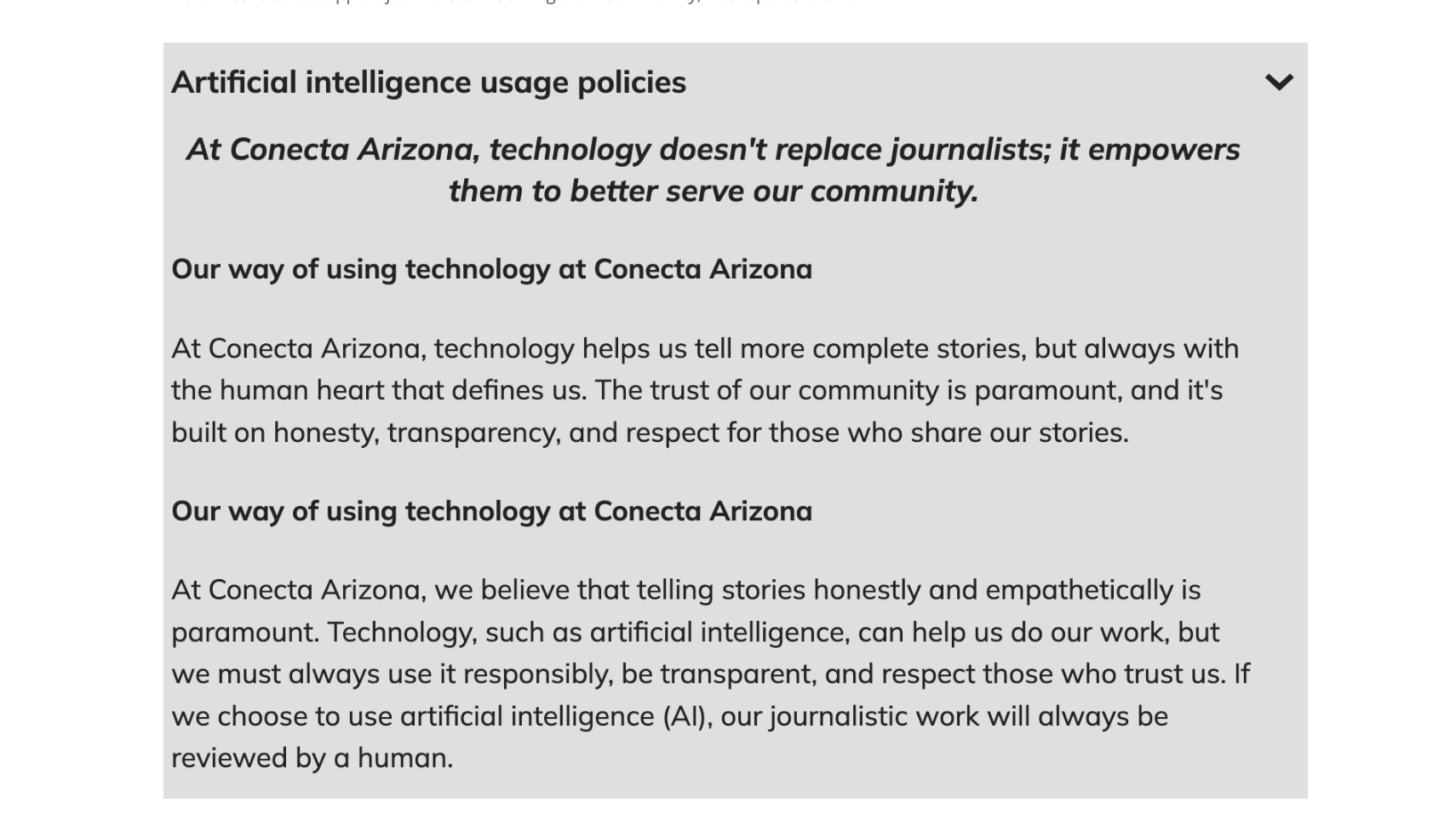
At the same time, the findings reinforce that transparency still matters deeply. Audiences continue to expect newsrooms to establish clear AI use policies and ethical guardrails around how these technologies are used in journalism. (Use our AI Trust Kit to get help being transparent about your AI use.)
The research also highlights the importance of engagement. Newsrooms should not assume they know what audiences want or need regarding AI coverage and explanations. Asking audiences directly about their questions, concerns and expectations can help organizations create more useful and trusted resources.
Tools to help you create AI literacy content
We have a new AI Literacy Trust Kit to help you share AI literacy content. In the kit you will find:
- Use this survey to ask your audience what they want to know, what they are worried about, what formats information is the most helpful, etc.
- Share the AI literacy content we asked the public about. We have created:
- Consider hosting an AI literacy event. Newsrooms found that hosting events focused on how AI works and how newsrooms use AI can build trust with their audience. Find out more about these events and sample agendas to host your own.
When news organizations provide useful, practical and relevant AI literacy information, audiences respond positively. Many people said the content helped them better understand AI, many wanted to see more of it and many reported increased trust in the newsroom after viewing even one piece of content.
The research also reinforces that transparency and engagement still matter deeply. Audiences continue to expect ethical guardrails and clear policies about how newsrooms use AI.
Ultimately, this work points to a broader opportunity for journalism. As AI continues to reshape how people access information and experience the world, journalists have a chance to serve not only as adopters of technology, but also as guides and educators who help the public understand it. Audiences want help making sense of AI, and this research suggests they are willing to turn to journalists for that help.
At Trusting News, we learn how people decide what news to trust and turn that knowledge into actionable strategies for journalists. We train and empower journalists to take responsibility for demonstrating credibility and actively earning trust through transparency and engagement. Learn more about our work, vision and team. Subscribe to our Trust Tips newsletter. Follow us on Twitter, BlueSky and LinkedIn.

Assistant director Lynn Walsh (she/her) is an Emmy award-winning journalist who has worked in investigative journalism at the national level and locally in California, Ohio, Texas and Florida. She is the former Ethics Chair for the Society of Professional Journalists and a past national president for the organization. Based in San Diego, Lynn is also an adjunct professor and freelance journalist. She can be reached at lynn@TrustingNews.org and on Twitter @lwalsh.