It’s not enough to just say someone’s an “expert” and leave it at that. Instead, how can you explain why, out of all the professionals and experts out there, you chose to interview or quote the ones you did?
Unpack labels we assume everyone understands
Want to get this Trust Tips newsletter in your inbox each Tuesday? Subscribe here.
Even though our goal as journalists is to be clear and concise, we often use words and terms in our coverage that actually aren’t all that easy to understand.
One place this especially shows up is in how we label content. We use terms like “news analysis,” “commentary,” “column,” “reporter’s notebook” or “editorial” to differentiate types of coverage. But for many people, these terms likely carry little to no meaning.
And why would they? For one, these aren’t words most people use in their everyday vernacular. Plus, these terms aren’t even used with universal meaning across the media industry. What would be considered a news analysis in one newsroom isn’t always the same in another newsroom. It makes sense that people might be confused by this. (If you need a refresher on best practices for labeling your non-news content, we have a whole guide here.)
Not only can this confusion lead to accusations of bias — which I saw happen plenty when working in local newsrooms — it might also contribute to people tuning out your news. Research shows one reason people say they avoid the news is because it feels confusing, full of jargon and overall, inaccessible.
As journalists, we should aim for clarity, and that includes clarity around which types of content we’re providing and what people can expect from us — especially when there’s so much mistrust already out there.
That’s why we love this example from Annelise Pierce at the Shasta Scout, one of our long-term partner newsrooms.
Here’s what the Shasta Scout did
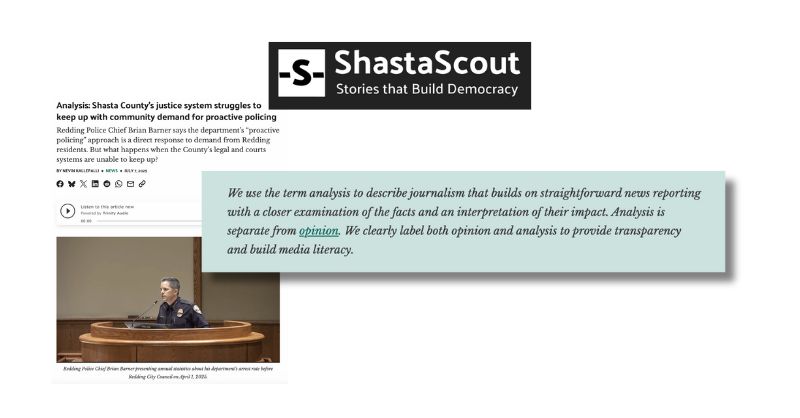
When publishing the newsroom’s first analysis piece, Annelise said she wanted to preemptively explain why the newsroom was sharing an analysis rather than wait for complaints or concerns from their readers. So, she added this short explainer to the top of this piece.

In this quick three-sentence note, Annelise explains what analysis means and that it’s separate from opinion, and she also includes some mission language around why they are careful to label their content. (Thanks to Annelise for reaching out to Director Joy Mayer for feedback on this explainer note! Our team is happy to offer suggestions on transparency elements your team is workshopping, as our capacity allows. Reach out to our team at info@trustingnews.org.)
Remember, many people don’t realize that analyses (or opinion pieces, for that matter) are often based on solid reporting and facts. And they don’t understand why news organizations would provide analysis and opinion as a service to their community. Why not spell it out?
These explainers can also help empower people with some basic news literacy skills. People are flooded with information, and often, that information can be infused with analysis and opinion that *aren’t* based on journalistic principles. What better way to help them understand what responsible analysis looks like than by modeling it to your audience?
You can add these explainers to the top of news stories, like Shasta Scout did in the example above, or include them in the chatter of social posts or the top of newsletters. To level up, you could even link to a longer explainer like this one from student newsroom The Griffin’s Nest, which lays out the different types of content.
Like a lot of transparency strategies, this can seem really simple and straightforward. But as journalists, we often take for granted how much the public understands about what we do and why we do it. Whatever you can do to explain our process, no matter how obvious it may seem to us, will help lessen the gap between your journalism and the public.
Two resources to help:
- This Opinion Trust Kit walks you through how to label content in a way that will travel with your stories, no matter where they end up.
- This Transparency Trust Kit dives into what day-to-day transparency can look like, and may help spur some ideas about other aspects of your work the public may not understand.
At Trusting News, we learn how people decide what news to trust and turn that knowledge into actionable strategies for journalists. We train and empower journalists to take responsibility for demonstrating credibility and actively earning trust through transparency and engagement. Learn more about our work, vision and team. Subscribe to our Trust Tips newsletter. Follow us on Twitter, BlueSky and LinkedIn.

Assistant director Lynn Walsh (she/her) is an Emmy award-winning journalist who has worked in investigative journalism at the national level and locally in California, Ohio, Texas and Florida. She is the former Ethics Chair for the Society of Professional Journalists and a past national president for the organization. Based in San Diego, Lynn is also an adjunct professor and freelance journalist. She can be reached at lynn@TrustingNews.org and on Twitter @lwalsh.