When journalists engage with their audiences and ask for input, it helps build trust. But the problem is that while more journalists are asking their communities for input, they’re not always acting on the feedback or sharing how that feedback is changing their coverage.
Acknowledge fair criticism and skepticism
Want to get this Trust Tips newsletter in your inbox each Tuesday? Subscribe here.
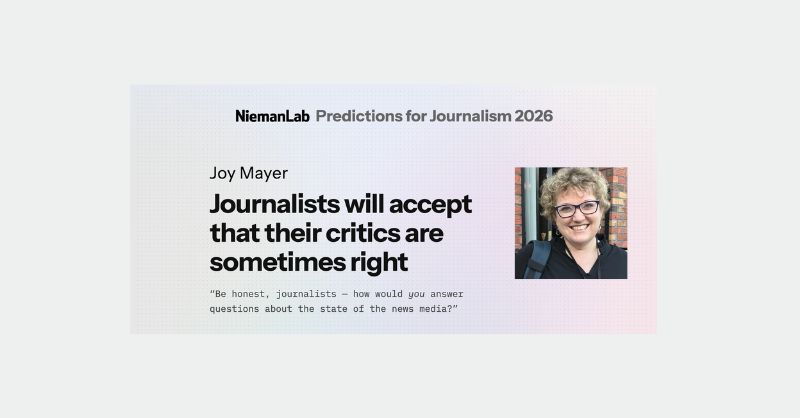
Note: This is excerpted and updated from my Nieman prediction that published in December.
“The media isn’t showing you the whole story.” That’s what a young friend said to me while we were driving home from her naturalization ceremony last month and talking about the politics of immigration.
My first reaction in conversations like that one is usually an irritated sigh. Here we go again. But the longer I study trust, the faster I am to pivot to validation. I mean, come on: OF COURSE my friend was seeing things in her community that journalists don’t notice or cover. And Of COURSE news stories don’t reflect ALL experiences or events. How could they?
Often, not showing the full picture is a function of basic editing and decision-making. But it is also true that journalists miss things, and that editing sometimes skews reality — either accidentally or intentionally.
My hope for journalists is that we will learn to make that quick pivot from defensiveness to agreement and to consider all the ways “the media” is falling short of its public service mission.
So, try this when faced with a complaint or accusation about “the media”:
- Don’t picture only your own work but remember that media sources blend together into a giant, confusing landscape.
- Think about all the things done in the name of journalism that make YOU the most frustrated or angry — across the wide range of podcasts, websites, social accounts, cable news, etc. It’s all part of the picture.
- Consider how confusing and overwhelmed your non-journalist friends feel when trying to tell what’s true. Spend time leaning into empathy for how complicated it is to try to be informed.
Don’t skip the necessary (uncomfortable) humility
Also, take a deep breath and consider that the accusations against us are sometimes accurate even for responsible journalism.
Of course we sometimes prioritize speed at the expense of accuracy or crucial context. Of course we sometimes report on things without fully understanding them.
And of course we superserve people who see the world like we do — and underserve or misrepresent people who see the world in ways we can’t relate to. So many people look at the news and think it was not made for or by people like them, and they are not wrong. They see news created through an urban, liberal, white, educated, secular lens (as I wrote in my 2021 Nieman prediction). And they are not wrong.
So, let’s stop defending all of journalism or complaining from on high about how disrespected and misunderstood we are by the people we’re supposed to be serving.Our time and energy would be better spent equipping people to navigate the chaotic information landscape and helping them understand how to separate responsible information from the rest of it.
Our goal should be to understand how well we are serving people and how we could be more useful rather than trying to win a debate about our relevance and value.
Please, let this be the year we move from a spirit of defensiveness to one of actually earning the public’s respect and attention.
At Trusting News, we learn how people decide what news to trust and turn that knowledge into actionable strategies for journalists. We train and empower journalists to take responsibility for demonstrating credibility and actively earning trust through transparency and engagement. Learn more about our work, vision and team. Subscribe to our Trust Tips newsletter. Follow us on Twitter, BlueSky and LinkedIn.

Executive Director Joy Mayer (she/her) founded Trusting News in 2016 after a 20-year career in newsrooms and teaching. She lives in Sarasota, Florida, and can be reached at joy@TrustingNews.org.