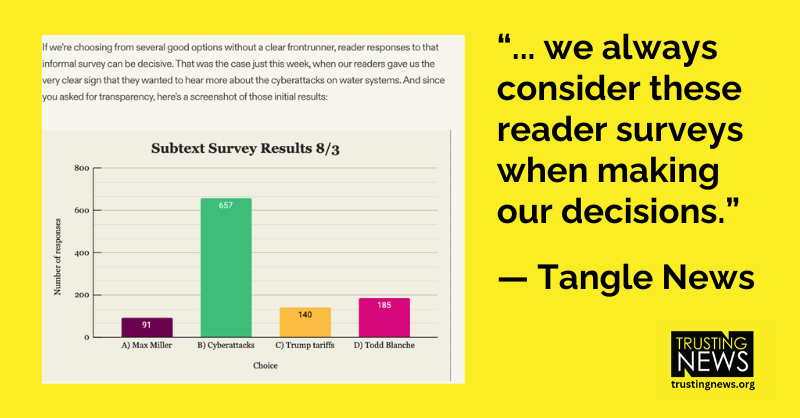
It’s common practice for many journalists to invite their audience to weigh in on potential coverage. It’s much less common to explain how that input is used (or even if it’s considered).
Show how audience input has influenced your coverage
Want to get this Trust Tips newsletter in your inbox each Tuesday? Subscribe here.
The editors of Tangle News got a perfectly valid question recently and addressed it in their newsletter:
Q: You regularly ask your readership to vote on a topic for you to cover. How do you use this vote? Do you always cover what the majority asks for? Do you sometimes consider the vote but then cover something else? Is this just a ploy to make your readers feel they have a voice in the topical coverage of Tangle? You owe your readers full transparency if you want our trust.
If you ask your audience for input or feedback (yes, those are two different things), you can bet they’re wondering what you’re doing with that information. Is anyone reading it? Do you actually care what people think? And most importantly, do you actually factor in their preferences when making coverage decisions?
Maybe you’ve gotten that question in comments or emails. Maybe you’ve even written back. But there are two things about how Tangle handled it that I want to encourage others to copy:
- They shared the question and their response with their whole audience, not just in an email or comment thread. This is key to making engagement more efficient and giving it more impact.
- Their answer was concrete (not just “of course we listen to you!”), and they brought the receipts of specific examples.
How Tangle answered the question
The editors used data to explain their decision-making through two scenarios.
Here’s one example of when readers had a clear preference for a specific topic and editors subsequently prioritized coverage of that topic.
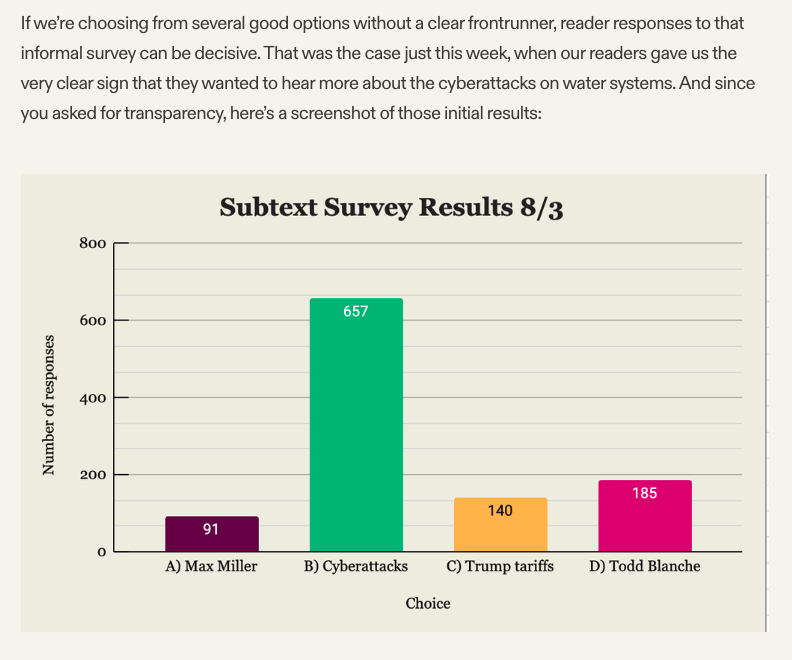
The next example was of a time the votes weren’t as decisive and the editors went a different direction (but also actually had explained in a different edition why they *weren’t* covering something that had gotten some votes!).
Here’s what the editors wrote in summary:
“Every week is a different story — sometimes readers reinforce our priors, sometimes we opt against the favorites, and other times the results are so decisive they end up setting our agenda. But we always consider these reader surveys when making our decisions.”
Where else can this information go?
Using a section of your newsletter is a fantastic way to share behind-the-scenes info like this. It reaches your loyal audience, and we found in an A/B experiment with PolitiFact that it increased audience perceptions of their work.
What if your newsletter answered one question each week?
How about social media? You could make one carousel or short-form video each week answering a question about how you operate as well. Maybe save them all in a playlist or pinned highlight?
Then what if you collected all the answers in an FAQ? It’s such an accessible, flexible format — as we’ve written about so many times. Make yourself a landing page where you routinely add answers to the public’s questions. And link back to those answers from daily coverage whenever possible.
Another example from Public Source
If your team has a habit around writing behind-the-scenes columns, that works well for this topic, too.
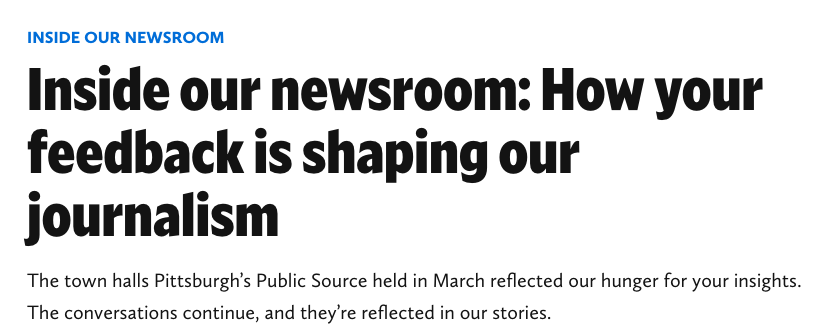
Halle Stockton, whose team at Public Source in Pittsburgh often leads the way when it comes to meaningful engagement, wrote a column last week that drew attention to coverage that was a direct result of the newsroom’s community listening sessions. The staff heard loud and clear that people were concerned about affordability and transportation, and that they wanted stories that “leave them feeling good or give them something useful to act on.” The journalists took that to heart, and Halle brought the receipts in this column.
She ended this way:
“We’re grateful to the hundreds of people who have taken the time to share their experiences, concerns and ideas. Your voices stay in our minds as we make decisions, ask questions and report. They’re making us better journalists. Please keep the conversation going. What should we be paying attention to next?”
More transparency guidance and formats
If you’re looking for more examples of how to bring transparency information to more formats and platforms, check out our Transparency Trust Kit.
At Trusting News, we learn how people decide what news to trust and turn that knowledge into actionable strategies for journalists. We train and empower journalists to take responsibility for demonstrating credibility and actively earning trust through transparency and engagement. Learn more about our work, vision and team. Subscribe to our Trust Tips newsletter. Follow us on Twitter, BlueSky and LinkedIn.

Executive Director Joy Mayer (she/her) founded Trusting News in 2016 after a 20-year career in newsrooms and teaching. She lives in Sarasota, Florida, and can be reached at joy@TrustingNews.org.