It’s not enough to just say someone’s an “expert” and leave it at that. Instead, how can you explain why, out of all the professionals and experts out there, you chose to interview or quote the ones you did?
6 data points every journalist should know
Want to get this Trust Tips newsletter in your inbox each Tuesday? Subscribe here.We’re always asking the question: What do people really think of the news?
We ask this question often because if journalists want to serve their communities well, we have to really understand the public perception of and habits around news (i.e., we can’t solve a problem if we don’t first understand what the problem is!).
One way to better understand these public perceptions is through research. But we know research can be hard to keep up with, especially if you’re a busy journalist. That’s why for today’s Trust Tips, we’re sharing a roundup of some impactful research from this past year that’s helped shape our team’s work and understanding of public trust in news.
We see part of our role at Trusting News as not only conducting research, but also helping translate research into action for journalists. We hope this list helps you better understand audience perceptions of news in a way that feels scannable and easy to digest.
We’ll also share suggestions for what journalists can do in response to each bit of research, and we hope it helps motivate you — or your colleagues, your bosses or your newsroom’s upper management — to make earning trust a central part of your mission and goals this next year.
If any of them feel particularly exciting or challenging to address, hit reply and let us know your thoughts. We’re happy to share advice, and your perspective will help us shape future programming.
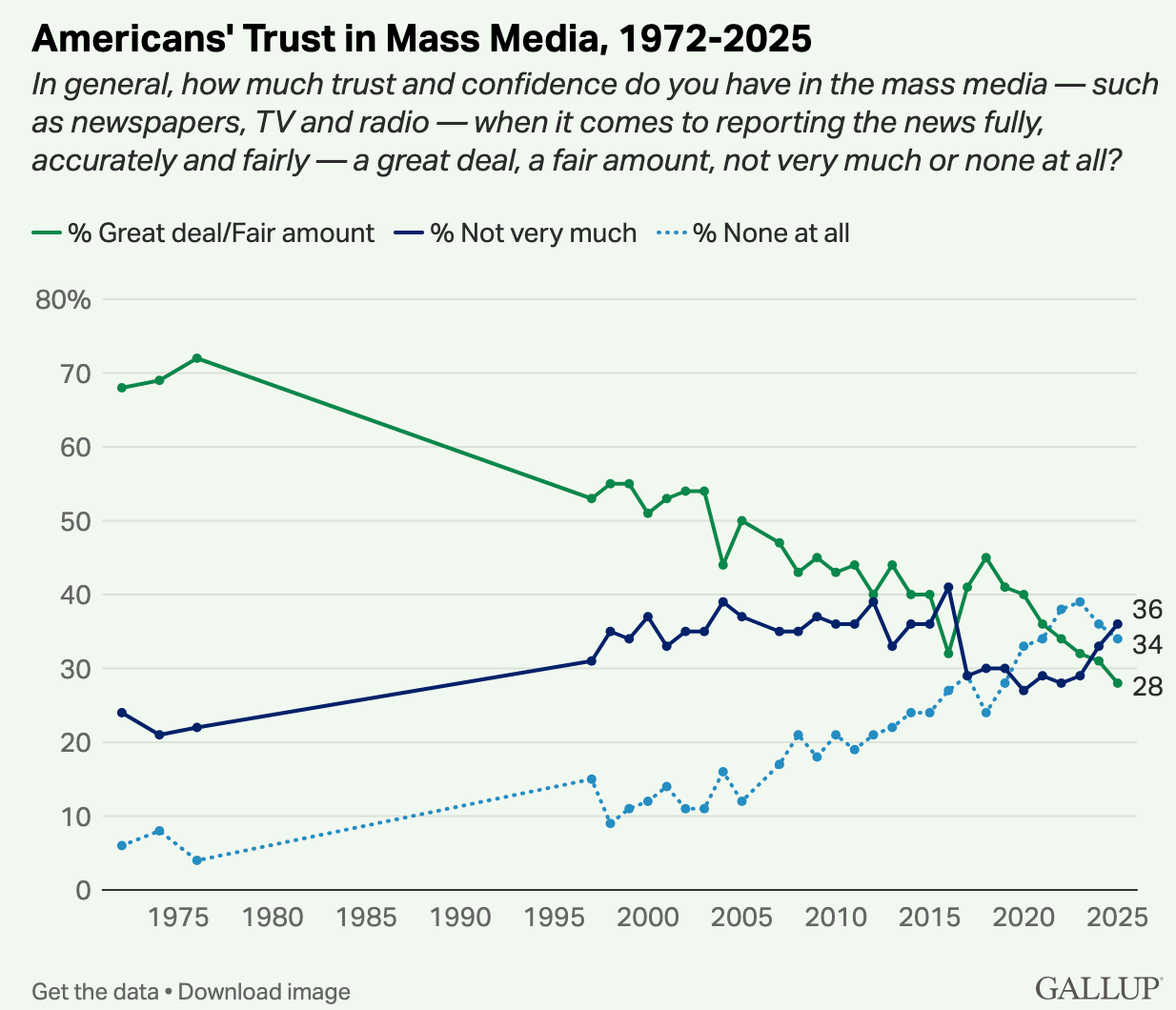
1. Trust in news is the lowest it’s ever been, with Republicans in single digits.
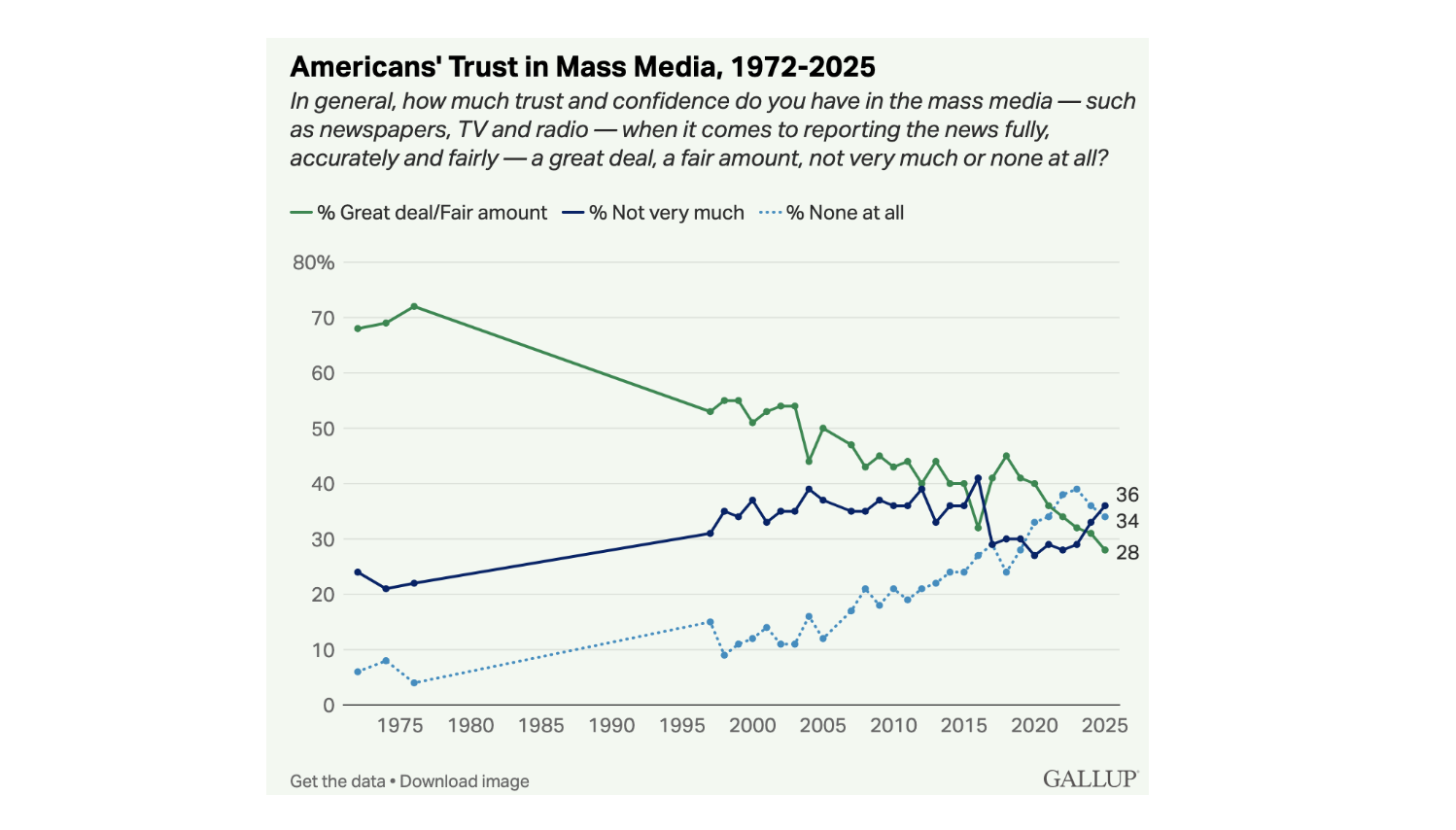
The public’s level of trust in news hit its lowest point ever this year, according to Gallup’s annual survey, with only 28% of people saying they feel confident the media reports the news fully, accurately and fairly. Another piece worth paying attention to: Trust is trending downward across the political spectrum. Republicans’ level of trust in news dipped to single digits for the first time (8%), while Independents’ and Democrats’ levels of trust trended downward as well.
What can you do? We should not only acknowledge that we’re facing a crisis of trust, but acknowledge that it’s up to us to address it. Yes, that means you! Whether you work in national or local media, in TV or a startup, independently or at a legacy organization — if you’re in a role where you inform any segment of the public, you should be deeply concerned about the declining levels of trust in news and actively make trust-building a crucial part of every newsroom strategy.
ALSO! If you are particularly concerned about earning trust across the political spectrum, you might be a good fit for some customized training and coaching we’ll be offering early in the new year. It’ll be free, thanks to a sponsorship from the Knight Foundation. Hit reply and let us know if you’d like us to alert you when that program is announced.
2. Language of democracy codes differently for different groups of people.
Press Forward commissioned research focused on how we can better make the case for journalism. In the report, researchers found “93% of people believe reliable local news is necessary for democracy, yet many of these same people react negatively to explicit ‘democracy’ messaging.” The report recommends avoiding using the word democracy when trying to get support for journalism because of this disconnect between how we as journalists often use the word democracy and what it actually means to the public. (This backs up PACE research that also shows how the word democracy means different things to different groups of people.)
What can you do? The report suggests avoiding the term democracy but not the concept, and instead, getting specific in describing how your journalism will benefit the community. But it’s also worth asking: Does this same problem seep into our daily journalism? Are we assuming our audience is all operating under the same understanding of democratic norms? And how might we better serve our communities by making a clearer connection between democratic norms and what’s happening in daily news? This is an area we’ve been exploring more, and recently dove into what this could look like in immigration reporting.
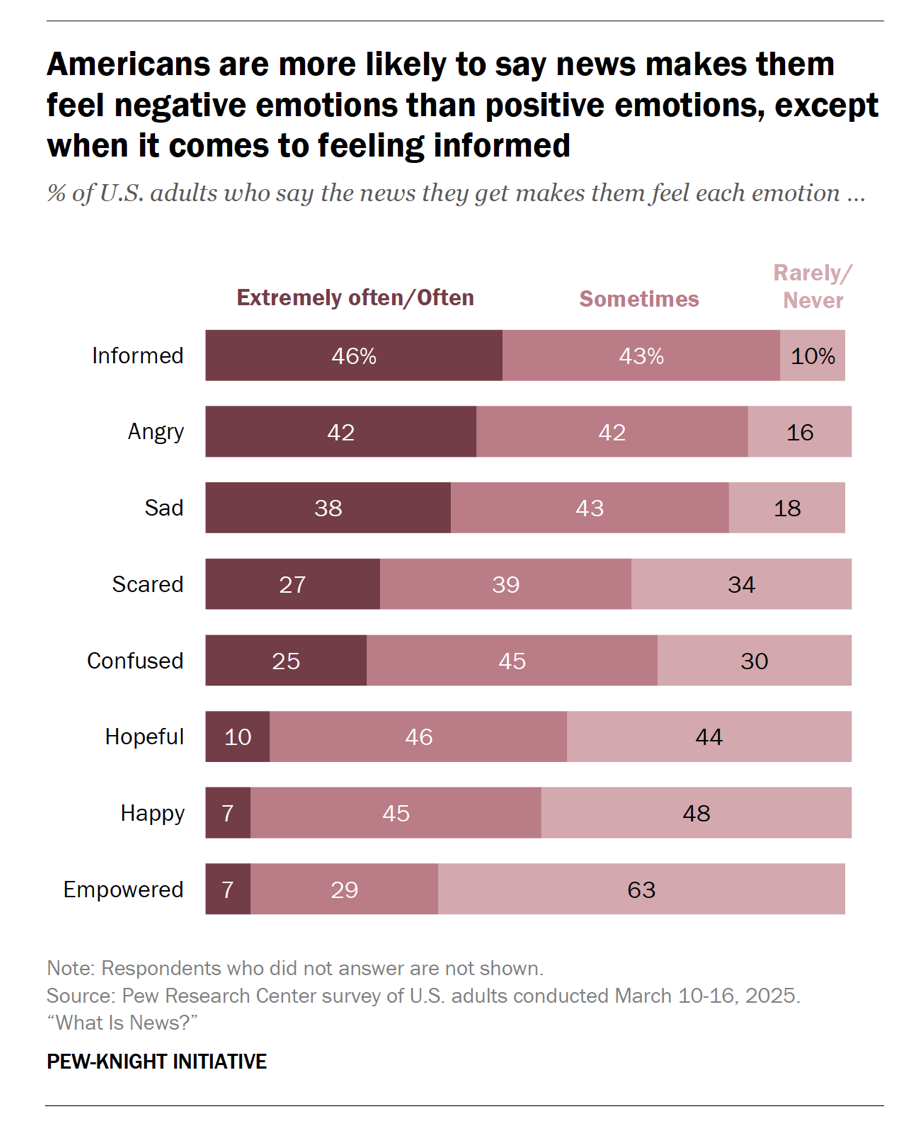
3. News makes people feel informed. But it’s complex.
The good news is that when Pew surveyed people about how the news makes them feel, the top answer was “informed”. However, the next four emotions people listed are all complex emotions — angry, sad, scared, and confused. (I can’t speak for every journalist, but I’d guess confused is NOT an emotion many of us would want people to feel when consuming our coverage.) We also know that people say negative emotions like these are one of the reasons why they avoid news in general.
What can you do? Start by investigating this disconnect that’s happening between what you’re trying to accomplish and what the public is perceiving. Get curious about whether you’re providing information that actually serves the people you are aiming to serve. And what better way to do this than by simply asking them? We have a whole conversation guide for how you can here.
4. Social media is Americans’ top news source.
A big news consumption shift that happened this year: Social media is now the top way Americans get news, having surpassed TV, according to Reuters. When people were asked about the best source for local information — even about a topic like local government — local TV did rank first. But more people choose social media than local newspaper or local radio. This is echoed in Pew research that shows one-in-five Americans say they regularly get news from online influencers, and that number increases with younger generations.
What can you do? Journalists can feel all kinds of ways about this shift, but none of the feelings change the reality of the information landscape we are in. It’s important to remember that journalists don’t get to decide if what they’re offering is useful and relevant. The public decides for themselves. Let’s keep our eyes on the end goal, which is ensuring our communities have access to good, credible information. Part of how we can do this is by getting curious about the value we’re providing our audiences and by helping them navigate where to turn for credible information.
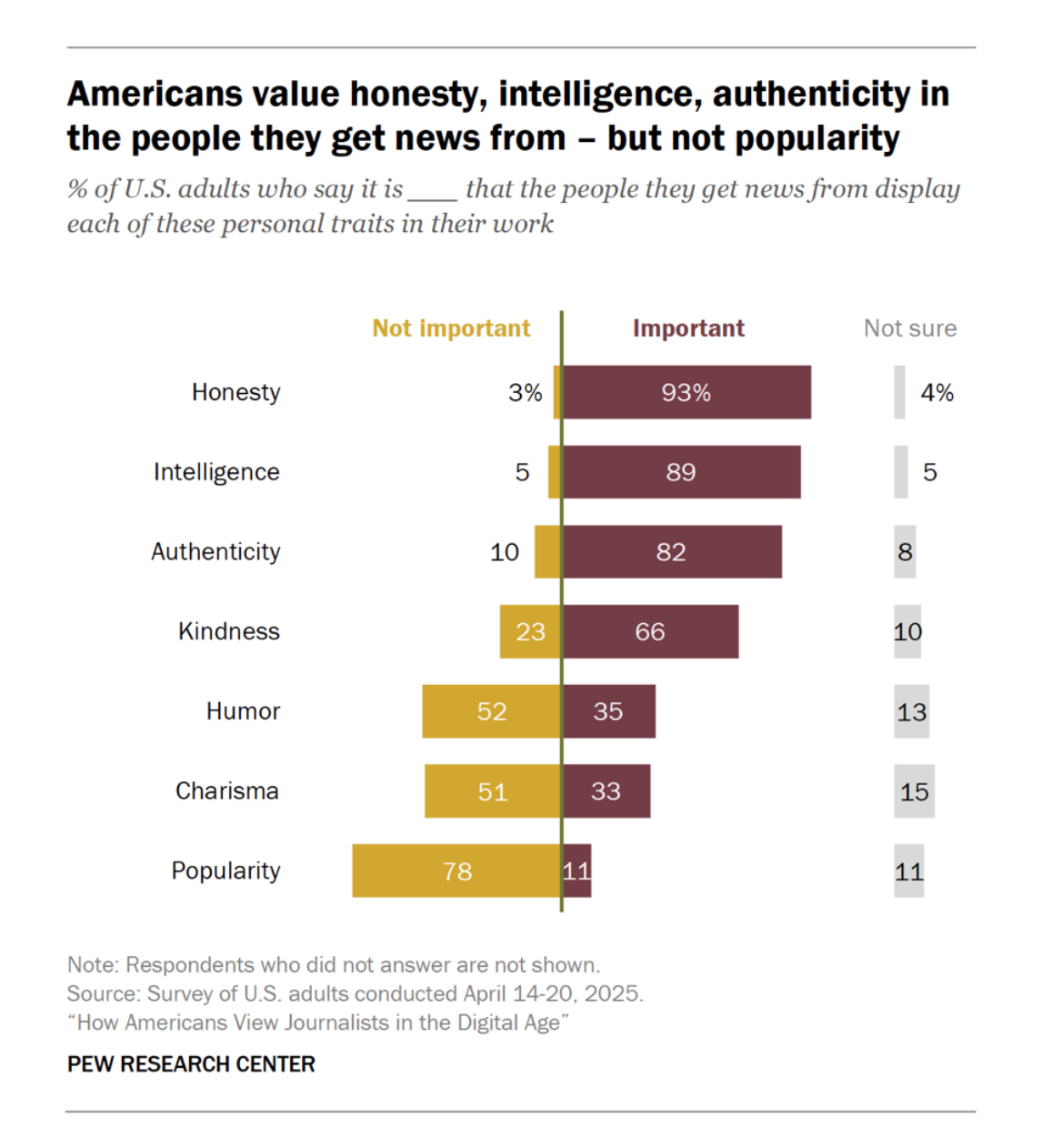
5. People say they want informers who are ‘honest’.
When Pew asked people what they wanted their news providers to be like, the top answer was honest, with 93% of people saying it is important. Now, you might be thinking: We are honest! But if our audience isn’t seeing that or making that connection, then our intent doesn’t matter. The fact of the matter is, if people say they want honesty, we need to make sure we are regularly signaling it to our audience.
What can you do? First, we need to start routinely telling our audience that our aim is to be fair and honest. Then, we need to back that up with action. How can we point to evidence that we’re working with integrity? How can we get transparent about our process with our audience? We have a lot of ideas of how you can do this in our Transparency Trust Kit. Also consider explaining how you know what you know. Our Trust Kit on Explaining Sourcing can help.
6. People are skeptical about AI — and want to know if journalists use it.
We’ve been investing in research to better understand the public’s wish list when it comes to how journalists use AI. We released another round of research this year with Dr Benjamin Toff at the University of Minnesota that reinforces our previous findings: People want journalists to disclose their use of AI. The more complex piece of the research was that people’s reaction to learning that AI had been used tended to be stronger than any reassurance provided by detailed disclosures about how that use was responsible. But since people say they want transparency around AI, we still recommend journalists prioritize being open and transparent about any use of AI in their coverage.
What can you do? First get curious about what YOUR audience thinks about AI. (We have tools for how you can do that here.) Then, get busy getting transparent about whether you do or don’t use AI. If you’re not sure how to do this, we have a lot of resources for how to write an effect AI disclosure here.
We’re here to help!
As you absorb or revisit any of this data from the past year, remember that you don’t have to go at it alone! There are so many amazing journalists working to tackle the declining trust in news (this includes many of you who subscribe to the newsletter!). If you could use help or guidance around where to start or level up your own trust-building, please reach out by replying to this email! We love to hear from you
At Trusting News, we learn how people decide what news to trust and turn that knowledge into actionable strategies for journalists. We train and empower journalists to take responsibility for demonstrating credibility and actively earning trust through transparency and engagement. Learn more about our work, vision and team. Subscribe to our Trust Tips newsletter. Follow us on Twitter, BlueSky and LinkedIn.

Project manager Mollie Muchna (she/her) has spent the last 10 years working in audience and engagement journalism in local newsrooms across the Southwest. She lives in Tucson, Arizona, where she is also an adjunct professor at the University of Arizona’s School of Journalism. She can be reached at mollie@trustingnews.org and on Twitter @molliemuchna.