Congratulations to the first 11 grantees that are charting new paths forward
Congratulations to the 2026 Advancing Democracy Innovation Fund Recipients
Since 2022, the Advancing Democracy program has helped dozens of newsrooms and hundreds of journalists move beyond surface-level, horse race political coverage and invest in journalism that equips communities with the information they want and need.
The program is offered in partnership with The Solutions Journalism Network, Hearken and Trusting News. It guides journalists toward coverage that builds trust, centers communities, and highlights where and how progress can be made. Research shows that the participating jouranlists significantly improved their coverage.
Last year, as part of the new 2025 offerings, the teams launched the Advancing Democracy Innovation Fund. Now in its second round, we are proud to announce nine additional projects the fund will support. The grantees, listed below, will receive financial support and coaching to help them strengthen civic life and participation — and help solve community needs.
Learn more and sign up for alerts on the Advancing Democracy website.
Here are the nine newsrooms and their projects.
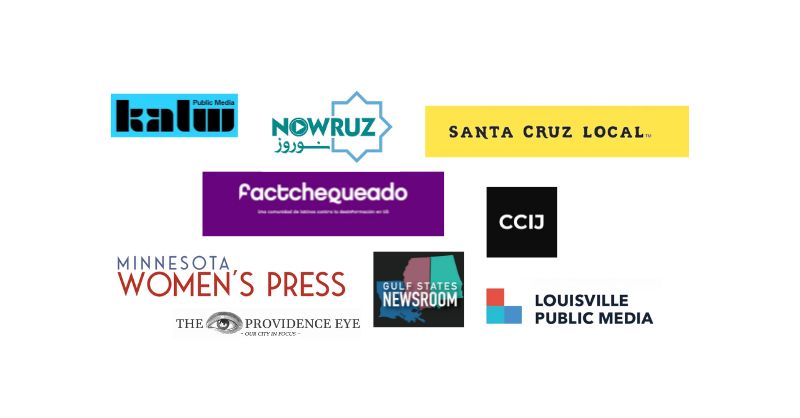
The Center for Collaborative Investigative Journalism (Grand Rapids, Michigan) will lead “How Power Works,” a multimedia explainer project designed to break down how elections and government actually function. Reporting will be shaped by questions gathered directly from community members, ensuring coverage reflects real civic information needs. Through clear, mobile-first explainers, the project will show who holds power, what different offices are responsible for, and where residents can realistically demand accountability. Guided by solutions journalism and trust-building practices, the project reframes democracy coverage as a practical public service and positions the newsroom as a reliable civic resource.
Factchequeado (Miami) will lead “What Helps Our Democracy Work?”, a community-centered solutions journalism project focused on the civic information needs of Spanish-speaking Latino communities. The project will begin with community listening, including an in-person event in Miami, to identify barriers to participation and examples of what has helped democracy function in practice. These insights will shape coverage examining evidence-based responses to challenges such as voter access, language barriers, misinformation, and trust in institutions. The project will also inform the continued development of Factchequeado’s civic tools, including Electopedia, a Spanish-language guide to U.S. elections, and Electobot, a WhatsApp-based chatbot that provides verified, nonpartisan election information. Both tools proved effective in closing information gaps during the 2024 election cycle and responding to thousands of election-related questions.
Gulf States Newsroom community engagement producer Nellie Beckett and public health reporter Drew Hawkins are embarking on a project to empower residents of Richland Parish, Louisiana, who are coping with the disruption caused by the building of Meta’s data center. (The regional newsroom encompasses WBHM in Alabama, MPB in Mississippi and WWNO/WRKF in Louisiana.) With support from the Advancing Democracy Innovation Fund, Beckett and Hawkins will train residents to act as citizen scientists and documenters, holding community events to build trust, train people in documentation and share the reporting that comes from this project, fusing engagement and solutions journalism to further democracy through transparency, inclusion and co-creation.
KALW Public Media (San Francisco Bay Area) will center 16- to 24-year-olds in its 2026 midterm election coverage using engaged journalism and The Citizens Agenda model. Rather than treating young people as a voting demographic, the project will elevate their voices by following youth-led efforts to overcome barriers to civic engagement, influence policymaking and increase youth representation in elections. The work began with a Youth Empowerment Summit on Jan. 31, designed as a deep listening session to identify youth priorities and define meaningful change. Insights from the summit will shape a co-created editorial road map, followed by a four-part solutions journalism series that examines successful models of youth civic participation, including Vote 16 initiatives and youth-led policy task forces.
Louisville Public Media (Louisville, Kentucky/Southern Indiana) will develop a project to improve the discoverability and community relevance of government accountability reporting focused on Southern Indiana. Reporter Aprile Rickert’s coverage currently appears alongside a high volume of daily newsroom content; this project will create a more intentional, community-specific entry point that speaks directly to local civic concerns. By making coverage more participatory and easier to engage with in a dedicated space, the project aims to build deeper trust with Southern Indiana communities ahead of the 2026 election cycle and better connect residents to voting and civic resources.
Minnesota Women’s Press (Minnesota) will produce three to five solutions-oriented stories examining how young people are engaging in civic processes to address mental health policy, gun violence prevention and environmental safeguards related to data center development. Each piece will focus on the legislative process, following students as they work with lawmakers, and will report on how bills are developed. The coverage will prioritize explanatory reporting that helps readers understand how governance and civic participation function in practice, rather than focusing solely on motivations or political outcomes.
Nowruz Media (California) will lead “From Silence to Voice,” a community-focused civic reporting project highlighting Afghan immigrant experiences with local government, elections and civic life. Using engaged journalism, solutions journalism and trust-building practices, the project will begin with Nowruz reporters listening to community members to understand their civic information needs. Nowruz Media will produce multilingual stories and multimedia explainers in Farsi and English, including two solutions-focused pieces: one exploring how Afghan immigrants successfully engage with local civic institutions, and another examining how trusted community networks reduce fear and misinformation and encourage participation in civic life.
The Providence Eye (Providence, Rhode Island) will provide comprehensive local elections coverage in 2026 through a combination of digital resources and in-person events. The project will pair evergreen civic education with timely reporting on hyperlocal races, helping residents better understand local government and election processes. By prioritizing clarity and accessibility, the coverage aims to support informed participation and strengthen civic knowledge ahead of local elections.
Santa Cruz Local (Santa Cruz County, California) will facilitate a series of community listening sessions that will inform a free, bilingual, multimedia election guide and help reduce political polarization in the county. The sessions will bring together residents across age, race and political differences to discuss local issues, collaborate on solutions and engage in civil dialogue. What participants share will directly shape the questions Santa Cruz Local asks candidates in its election coverage. The election guide will be distributed across the newsroom’s website, Instagram news service and Spanish-language WhatsApp channel, as well as in print through partnerships with local nonprofits.
At Trusting News, we learn how people decide what news to trust and turn that knowledge into actionable strategies for journalists. We train and empower journalists to take responsibility for demonstrating credibility and actively earning trust through transparency and engagement. Learn more about our work, vision and team. Subscribe to our Trust Tips newsletter. Follow us on BlueSky and LinkedIn.